Author: Nathaniel Kangpan

  • Client Letter #6: Why This Executive’s $2.9m Portfolio Was Underperforming

    Developing our own technology solutions, 529 passthroughs, fives issues our Portfolio Efficiency Audit identified in an executive’s portfolio, AI’s impact on careers for college students, will the next recession affect digital advertising?

    Dear Friends and Client Partners,

    We recently completed a Portfolio Efficiency Audit for an executive that led to them becoming a client. I’ll use today’s deep dive to go through five of the most impactful findings from this audit.

    If you’re a client, these will look familiar – we complete these audits for you during onboarding as we take over your portfolio and then regularly run new audits and optimizations on your portfolio that we discuss together during quarterly reviews.

    If you’re not a client, these may be a useful reference to check up on how your current advisor is doing. These are common gaps we see across nearly every portfolio we have taken over from other advisors. Depending on severity, these gaps can add up to tens of thousands per year in opportunity costs.

    But first, our company updates:

    Firm Updates

    Technology

    I spent nearly 20 years leading technology and analytics teams before becoming a wealth manager. It should come as no surprise that I’ve started codifying some of Kangpan & Co.’s most common processes and analyses into proprietary technology that we will be using to ensure your family’s wealth is optimally aligned to your long term goals. This technology sits alongside the best-in-class platforms we already use to serve you, filling in gaps that these other platforms have rather than aiming to replace them.

    There are two analytics modules that are now being tested on your accounts:

    • Tax-Efficient Asset Location: A rebalancing algorithm that monitors your allocations across account types (taxable vs. retirement) to help optimize for after-tax returns on your total portfolio.
    • Stagnant Capital: A monitoring system that looks across every account we oversee and flags any cash sitting on the sidelines that should be invested.

    You can read the Deep Dive below that discusses more about what client problems these modules help solve. We built these because we couldn’t find acceptable solutions elsewhere that met the standards with which we want to serve you. We’ll continue adding to our technology going forward.

    In Brief: 529 Passthroughs

    Many people overlook the 529 as a powerful in-year tax arbitrage tool, including the expanded $20,000 K–12 limit effective this year. Even if you didn’t fully pre-fund an account years ago, you can effectively use a 529 as a “tax-advantaged clearing account” for tuition or other qualified expenses. By pass through these costs, you capture immediate state tax deductions on dollars that were going to be spent anyway.

    If you’re not a client and are currently in the thick of paying educational expenses, let’s ensure you aren’t leaving easy tax savings on the table. Reach out if you’d like to understand any opportunities you may have.

    Deep Dive

    Five Structural Inefficiencies in an Executive’s $2.9m Core Portfolio

    Today’s deep dive is on the longer and more technical side for those of you interested in the details of what we’re doing behind the scenes and how that may differ from what other advisors do.

    Note, I’ve provided illustrative examples of the kinds of impact these analyses can have for a $2.9m portfolio rather than the specific numbers we found for this client. This is out of both respect for client privacy and regulatory constraints that limit how much detail I share about a specific client.

    That said, we were told the clarity of our audit and the quantified impact of the findings directly led to this client joining Kangpan & Co.

    The five analyses from our audit we’ll highlight here are:

    • Performance Benchmarking
    • Loss Harvesting
    • Tax-Efficient Asset Location
    • After-Tax Yield Optimization
    • Stagnant Capital

    I. Performance Benchmarking

    The first step of any audit is a cold, hard look at reality. We compare the performance of the current portfolio against an objective benchmark comprised of low-cost, passive ETFs across:

    • Global Stocks
    • US Stocks
    • Bonds

    This is a fairly straightforward exercise but we’ve found that most clients have never really sat down to do this. Even clients working with other advisors have rarely (if ever) seen their portfolio results compared to a simple benchmark portfolio.

    Being an effective multi-asset portfolio manager means understanding where to accept the market return and where active management is more likely to add value to a portfolio.

    Certain benchmarks are statistically hard to beat. S&P found 88.3% of active managers underperformed the S&P 500 index over the past 15 years.

    However, that same report shows 40.7% of US Muni Managers beat their index over the same 15 year timeframe.

    Knowing the benchmarks is important because the costs of underperforming are significant. A $2.9m portfolio moderately underperforming its benchmarks could be losing:

    • $14,500 a year if you underperform by 0.5%
    • $29,000 a year if you underperform by 1.0%
    • $43,500 a year if you underperform by 1.5%

    When we add or remove assets from our portfolios we are looking at how that individual asset has performed vs. a set of relevant benchmarks and potential opportunity costs. For example, a Private Real Estate fund will be compared against a broad, low-cost REIT index. But we also look at how incorporating an asset affects the overall portfolio’s structure. Does incorporating this asset increase overall returns? Does it decrease risks or correlations to economic shocks?

    If we’ve done a quarterly review together, then you know we transparently report out how our multi-asset portfolios perform against passive benchmarks. We think it’s important to remain intellectually honest with you and ourselves so that we have the data to consistently improve our investment strategies and processes.

    II. Loss Harvesting

    It’s never fun to look at your portfolio and see losses in your positions. Loss harvesting is the process of strategically making use of these losses to:

    • Deduct up to $3,000 a year from your income taxes
    • Help rebalance your portfolio while minimizing capital gains taxes
    • Reduce the future taxable gains on other positions

    It’s easy to quantify how much tax-loss harvesting opportunity may exist in a portfolio at any single point in time. Just look at the total dollar amount of losses you have.

    What’s more complicated is figuring out what to do about these losses such as understanding the tradeoffs between:

    • How much you should actually harvest
    • Whether to offset a winning position or take the tax deduction
    • Which winning positions to offset with losing ones
    • Whether to move your losses into cash or another type of position

    While you can tell how many losses you have on any given day by checking your portfolio, it’s harder to estimate how much benefit tax-loss harvesting might deliver over time.

    Research from JP Morgan suggests someone regularly contributing to their portfolio and taking advantage of active tax loss harvesting could harvest up to 1.0% a year in tax benefits.

    For a $2.9m portfolio, that means tax-loss harvesting could deliver:

    • $0 if all your assets were stable or steadily increasing all year
    • $14,500 a year at 0.5% in realized tax-loss harvests
    • $29,000 a year at 1.0% in realized tax-loss harvests

    Many advisors or self-managed investors will do tax-loss harvesting just once a year. While that’s better than not doing it at all, we feel more regular tax-loss harvesting throughout the year bring better benefits to clients. This better captures ongoing tax opportunities, maintains target asset allocations, and continuously reduces the cost basis of appreciated positions.

    III. Tax-Efficient Asset Location

    This analysis checks to make sure assets that are:

    • Tax-inefficient, such as bond ETFs that generate substantial taxable dividends, are placed in tax-advantaged accounts such as 401ks, IRAs, and Roths
    • Tax-efficient, such as large cap growth stocks that typically pay very low dividends, are placed in taxable accounts

    There are two primary benefits to doing this. First, the dividends / distributions from assets that create significant taxable payments like bond funds are no longer taxed. Second, we can rebalance assets without incurring capital gains taxes.

    Let’s look at the math behind shielding dividends from taxes.

    Like many of you who subscribe to this letter, let’s say your family’s income is in the high six figures and you live in a high-tax state. Your federal tax rate is 35% and your state tax rate might be something like 7.5%.

    If you put $1,000,000 into a bond ETF with a 4.0% yield, you would get $40,000 in dividends over the course of the year.

    • If you hold this position in a taxable investment account you could end up paying $17,000 in taxes ($40,000 * combined tax rate of 42.5%) which means you’ll only keep $23,000
    • If you hold this position in a tax-advantaged account you would pay $0 in taxes on these dividends and keep the full $40,000

    The benefits to making use of tax-efficient asset location can be significant.

    However, many portfolios we’ve reviewed from clients working with other advisors don’t do this. There are various reasons we can think of for why this may be… but none have to do with what is in the best interest of clients.

    The primary challenge is that it is more analytically and operationally complex to manage portfolios this way and many automated trading tools available to advisors are not able to handle portfolio structures like this. Most firms avoid this level of detail because it is hard to scale. We lean into it because we embrace complexity since that’s where value is found for our clients.

    Unless there’s a reason to do otherwise, we take advantage of Tax-Efficient Asset Location when managing our clients assets and will go through the work it takes to migrate portfolios to this kind of approach.

    IV. After-Tax Cash Yield Optimization

    As we mentioned in Client Letter #3: Leaving a C-Level Corporate Career, we regularly optimize the yield of our client’s cash positions.

    We model more than a dozen different vehicles to find the optimal one for each client based on their unique tax situation. But we don’t just look at the topline yield number. The after-tax yields on these assets can vary significantly.

    Each of these vehicles has a different tax treatment – for example, high yield savings accounts are generally taxed at both the federal and state level while short term treasuries are primarily taxed at the federal level but often exempt from state taxes.

    Many of our clients’ cash strategies allocate between $100 to $250k to meet short term liquidity needs.

    For someone with $250k in cash, the incremental yield you could get from optimizing for after-tax returns are:

    • $2,500 a year if you get an extra 1.0% in after-tax yield
    • $5,000 a year if you get an extra 2.0% in after-tax yield
    • $7,500 a year if you get an extra 3.0% in after-tax yield

    It’s worth noting, we typically find a high yield savings account is not the best vehicle for optimizing after-tax yields.

    V. Stagnant Capital

    This is when you have cash that has unintentionally built up in your portfolio which is not being invested into higher returning assets. This tends to happen when dividends aren’t being reinvested or when you have retirement accounts from old jobs you’ve forgotten about over the years that haven’t been checked in awhile.

    It’s not surprising to see Stagnant Capital in portfolios that our clients were previously managing themselves – they’re busy executives that aren’t constantly thinking about their portfolios. What has been surprising is seeing how many portfolios we take over from other advisors and institutions that have significant amounts sitting in cash.

    We don’t just consider this “idle money,” but a significant opportunity cost in terms of reaching your long term goals.

    For every $100,000 in Dead Cash, you could be actively losing:

    • $3,000 a year in interest if you just moved it to a high yield savings account with 3.0% interest
    • $4,500 a year in distributions if you have an income-centric portfolio strategy targeting 4.5% in yearly yield
    • $9,000 a year if you have a more growth-centric strategy targeting 9.0% yearly total returns

    At Kangpan & Co., we don’t rely on manual oversight or ‘occasional’ checks. We’ve built a systematic cash-monitoring algorithm across our entire firm. This ensures that Stagnant Capital is regularly identified and re-deployed, maintaining the structural efficiency of the portfolio regardless of how busy our clients’ lives become.

    After the Audit

    These are just some of the highest level optimizations we identified for this executive’s portoflio before we started officially working together.

    Since onboarding this client, we:

    • Fixed many of the gaps that our audit identified
    • Developed a new portfolio strategy that incorporates alternative assets to help improve the diversification and resilience of the portfolio to different economic shocks
    • Realigned and rebalanced hundreds of thousands of dollars in assets across our client’s portfolio while incurring nearly zero capital gains taxes in the process
    • Are exploring integrating private assets to further align the risk / return profile of the portfolio to our client’s long term goals

    If you’re not a client and you suspect your portfolio may have performance or efficiency gaps, email me with the subject or body “Audit.”

    If we feel we can add value to your portfolio, we’ll run the same Portfolio Efficiency Audit we used for this executive. It’s a complimentary analysis and takes about an hour of your time in total. Even if we don’t work together afterwards, you’ll know exactly where your portfolio needs to be optimized.

    Food for Thought

    A collection of articles or books I’ve read that might be interesting to many of you.

    • AI job disruption may be good for children via the FT: A number of you with kids in or nearing college and expressed to me some concerns they may be picking career paths for prestige and money rather than what they may ultimately enjoy or be good at in the long run. I’ll be writing more about this topic in a future deep dive and this was a thought-provoking article in the meantime. As the FT writes:

    “We have legions of young people who have worked out how to get into great universities, get good grades and land prestigious internships. But when you ask them what they are passionate about, their faces go blank.”

    • Are Meta and Google ads really recession proof? via the Economist: A significant portion of subscribers are in the advertising or marketing industry. I’d be curious to get your take on whether digital ad budgets are likely to be cut during the next recession. Reach out if you want to chat about this. As the Economist notes:

    “The recessions of 2008-10 and 2020 are also an imperfect sample from which to extrapolate the future of digital ads. It is true that in both those cases online advertising held up even as offline varieties fell off a cliff. Yet in 2007-09 digital ads were climbing from a tiny base, so migration of advertising from print and television to the internet offset cyclical weakness. Now that digital advertising is so dominant, there is less offline share to snaffle.” 

    Thank you for the continued partnership and for the opportunity to help steer your family’s capital toward what matters most.

    Nathan
    Founder & Lead Advisor

    Not a client yet? 

    Subscribe to this bi-monthly client update for free to see all the engineered tax, investing, and planning strategies we run for high-earning and high net worth investors like you.

    Or reach out to us for a complimentary, 30-minute Portfolio Efficiency Audit Preview session to see what tax, investing, and planning opportunities your current strategy or advisor is overlooking.

    Disclosures: This content is for educational purposes only and is not investment, tax, or legal advice. No post is an endorsement of any particular strategy or security. We do not receive any direct payments or commissions for securities discussed in our posts. Employees and clients of Kangpan & Co. may hold positions in securities discussed in posts. Speak with a licensed tax, legal, or financial advisor before making any changes to your investments or financial strategies. Past performance is no guarantee of future returns. Investing involves risk including the loss of capital.
  • Client Letter #5: The Opportunity Costs of Over-Saving

    Incorporating Private Assets into our strategies, Bitcoin as a portfolio hedge, the problem with not knowing how much is enough, concentrated stock positions, 1929

    Dear Friends and Client Partners,


    In this week’s Deep Dive we’ll talk about how to avoid the unintentional consequences of staying in a job for the paycheck when you already have enough to move on to something you’re more passionate about.

    But first, a quick announcement that I’m particularly excited about for Kangpan & Co. clients.

    Firm Updates

    Partnerships: Institutional Private Market Access

    We secured a partnership with a premier provider of private fund access, specifically designed for independent wealth firms. For clients who meet Accredited Investor standards, this provides a streamlined path into institutional-grade Private Credit, Private Equity, and Real Estate—asset classes that have traditionally been the domain of the world’s largest endowments and family offices. We will be discussing these options with eligible clients in the coming months to determine how private market exposure may complement your current strategy and to review the specific tradeoffs, such as illiquidity and diversification benefits.

    Research: Bitcoin as a Portfolio Hedge?

    We get lots of questions on whether Bitcoin can act as a hedge against equity volatility. Our recent analysis shows the opposite: it’s increasingly acting as a high-beta equity proxy.

    Deep Dive

    The Problem with Not Knowing How Much is Enough

    When I was getting licensed as a wealth manager, I assumed my primary value to clients would be technical: optimizing asset class returns or uncovering marginal tax savings. That’s why we use all kinds of sophisticated systems at Kangpan & Co. to model expected returns, run Monte Carlo simulations, and forecast dynamic withdrawal bands.

    However, these tools can’t answer the truly fundamental questions like:
    What are you saving for

    The more people I sit down with, the more I realize my most valuable work is helping clients bring clarity to their vision for their future lives. 

    Most people I meet with are saving and investing for a desirable but vaguely defined future. It’s usually “early retirement” or a “second act that is more aligned to long-term values.” 

    But the planning usually stops short of quantifiable specifics. Important details remain unanswered or only loosely defined.

    Are you going to keep living in the same high cost of living suburbs that you raised your family in? Do you want to maintain your current lifestyle or enhance it? Are you going to sell the business you’ve built or transition it to the next generation and live off its distributions? 

    You need to understand what your dream life will actually cost to live. If you don’t know what you’re specifically aiming for, you’ll have no idea if you’re even pointed in the right direction.

    Advisors often talk about the risk of not saving enough for retirement… which can be a problem. But it’s a pretty well-understood one.

    There is an equally problematic issue that’s not talked about enough: over-saving. 

    It’s very easy to get caught up in the momentum of the day-to-day and forget what your actual long-term goals for your life are. So you keep working and grinding and saving up more and more. You end up spending years longer than you needed to working in a job that you’re not passionate about that’s slowly eroding the most valuable asset you have, the rest of your life.

    You often need far less than you think to step away from what you’re doing today to start that next phase of your life. Some of my most rewarding work so far has been helping people realize they are much closer to financial independence than they imagined.

    The key to this assessment isn’t a complex investment product. It is the process of crystallizing and quantifying your goals. Once defined, we can engineer a personalized Playbook to reach—or even accelerate—that timeline. 

    This is exactly what I did for myself. I sat down in my early 30s and thought deeply about what I wanted from life and then iteratively built a personal Playbook to ensure I was able reach my goals before 40. 

    I focused on three quantifiable requirements:

    • A home Sheila and I both loved that our family could grow into with excellent K-12 public schools
    • The ability to go out to different restaurants in the area at least once a week as a family (and there is no shortage of places to try in the Philly area)
    • Going on three to four nice vacations together each year

    Beyond the numbers, I wanted a post-corporate work life defined by three types of independence:

    • Financial independence to build Kangpan & Co. intentionally, choosing only the clients I am best suited to serve
    • Schedule independence to ensure I never miss the important moments in the lives of my family and loved ones
    • Moral independence to ensure there are no conflicts of interest or compensatory arrangements that sacrifice the objectivity of the advice I provide to clients

    Making steady progress against these specific goals over the years allowed me to “retire” from a C-level role before 40. Each month I spent 30-minutes review my Playbook to ensure our costs, savings, and investments were on pace to meet these quantified goals. 

    Once I hit my target numbers, I shifted my portfolio towards an all-weather, multi-income investment strategy that would support my family’s financial needs in perpetuity. I then started the next phase of my life. 

    I increasingly think effective wealth management boils down to this:

    Envision the life you want and engineer your finances to make it a reality.

    That’s what I did for my own family and that’s what I love doing for the families I serve. This ethos is the foundation of Kangpan & Co.’s Personal Endowment framework that I’m steadily building to support our client base.

    If you aren’t a client yet but want a thought partner to help you quantify your vision for a more intentional financial future and engineer the strategies to get there, feel free to reach out.

    Food for Thought

    A collection of articles or books I’ve read that might be interesting to many of you.

    “Although continuing to hold a concentrated stock might seem like a status-quo stance, it is, in fact, one of the most risky investment strategies an investor could pursue, and it is especially problematic for those wealth creators who seek to become guardians of wealth for themselves and their families… Bessembinder (2018) shows that, during the 1926–2016 period, for all the 25,967 common stocks in the Center for Research in Securities Prices (CRSP) database, by far the most frequent one-decade buy-and-hold return is -100%.”

    • 1929 by Andrew Ross Sorkin: The first part of the book examines the build up to the crash of 1929 that led to the Great Depression. It’s a fascinating mirror of many of the same dynamics we’re seeing in markets today. I personally wasn’t a fan of the last third of the book focusing so heavily on the nuances behind the passage of the Glass-Steagall act but the entire book is highly readable for such a heavy topic.

    Thank you for the continued partnership and for the opportunity to help steer your family’s capital toward what matters most.

    Nathan
    Founder & Lead Advisor

    Not a client yet? 

    Subscribe to this bi-monthly client update for free to see all the engineered tax, investing, and planning strategies we run for high-earning and high net worth investors like you.

    Or reach out to us to get a complimentary, 30-minute Diagnostic to see what tax, investing, and planning opportunities your current strategy or advisor is overlooking.

    Disclosures: This content is for educational purposes only and is not investment, tax, or legal advice. No post is an endorsement of any particular strategy or security. The Personal Endowment is a conceptual investment framework customized to each client and does not represent a specific fund or guaranteed outcome. Asset allocation and yield targets are subject to market volatility. We do not receive any direct payments or commissions for securities discussed in our posts. Employees and clients of Kangpan & Co. may hold positions in securities discussed in posts. Speak with a licensed tax, legal, or financial advisor before making any changes to your investments or financial strategies. Past performance is no guarantee of future returns. Investing involves risk including the loss of capital.
  • Research Notes: Bitcoin as a Portfolio Hedge?

    Since we are a multi-asset manager, many of our clients ask whether Bitcoin can act as a hedge against short to medium-term volatility of the stock market.

    We like to use data to inform how we answer questions so we decided to take a look at:

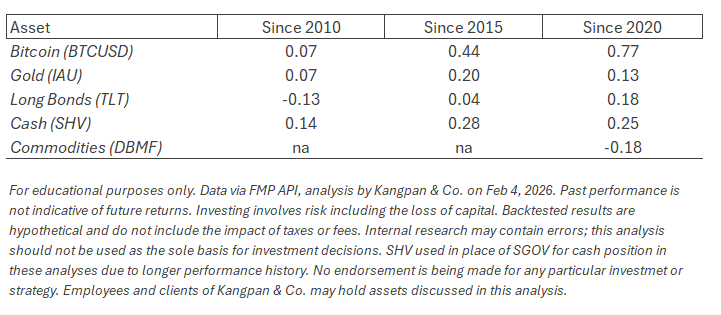
    • The correlation of rolling 1y returns of the S&P 500 vs Bitcoin and other assets that are commonly used to hedge the equity portion of portfolios
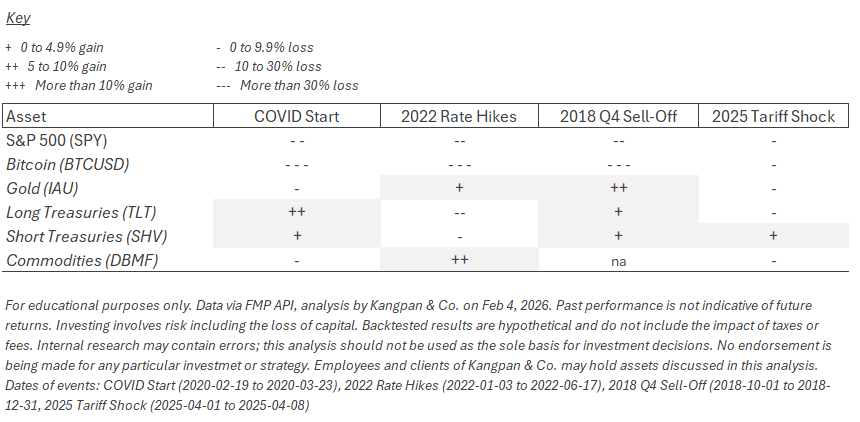
    • How these same assets have performed during some of the more recent S&P 500 drawdown events

    Key Finding 1: Bitcoin’s correlation to the S&P 500 has steadily increased since 2010

    The table below shows 1yr return correlations between the S&P 500 and various assets. We have provided the tickers we used to proxy each asset class’s return.

    There are two points we want to highlight in this table:

    • Between Jan 1, 2010 and today, Bitcoin shows a 0.07 correlation to the S&P 500; but that low correlation appears to be heavily skewed by Bitcoin’s behavior in its early years. The correlation steadily rises to 0.77 since 2020 suggesting Bitcoin is acting more and more like a leveraged portfolio of equities than a non-correlated asset.
    • No other asset in the table shows a correlation greater than 0.30 across the time periods assessed.

    Key Finding 2: Bitcoin has generally experienced sharper drawdowns than the S&P 500 index during recent equity shocks

    The table below shows the relative performance of each asset during notable events that led to significant drawdowns in the S&P 500 over the past 10 years.

    • In three out of four of these events, Bitcoin experienced greater drawdowns than the S&P 500
    • No other assets in the table below experienced sharper drawdowns than the S&P 500 during these events. In all drawdown events at least one of the other assets experienced gains.

    Bitcoin does not appear to act as a volatility hedge for equity portfolios

    These two analyses suggest Bitcoin has not historically functioned well as a short to medium term hedge to equities (as proxied by the S&P 500). Instead, it has exhibited an increasing correlation in recent years and has experienced significantly sharper drawdowns than the S&P 500 in three out of four of the shock events analyzed. 

    I’m not against clients holding bitcoin – that’s an individual decision depending on how much you allocate, your risk tolerance, and what your point of view on Bitcoin’s long term prospects are. However, this analysis suggests that holding it as a short to medium term hedge to volatility in stocks is not a role it has played well.

    Hedges should exhibit low to negative correlation like some of the other assets in the analysis. When we design the hedge portions of our clients’ portfolios we are generally looking for assets that move more independently of equity holdings.

    As a disclaimer, I have a small amount of bitcoin – out of interest in the underlying technology and as a way to more closely follow how the crypto markets evolve over time – not as a hedge to anything in my core portfolio.

    Disclosures: This content is for educational purposes only and is not investment, tax, or legal advice. This post is not a solicitation for business. No post is an endorsement of any particular strategy or security. We do not receive any direct payments or commissions for securities discussed in our posts. Employees and clients of Kangpan & Co. may hold positions in securities discussed in posts. Speak with a licensed tax, legal, or financial advisor before making any changes to your investments or financial strategies. Past performance is no guarantee of future returns. Investing involves risk including the loss of capital.

  • Client Letter #4: Living Off a Portfolio’s Income

    2025 Tax Planning Summaries, engineering a Personal Endowment, capital-intensive infrastructure bubbles, and a primer on income-centric investing

    Dear Friends and Client Partners,

    In this week’s deep dive I’ll be talking a bit about the income strategy I’ve used to create the cashflows that support my family. This portfolio income took the place of my C-level salary when I left the corporate world and also provides the cashflow that allows me to be intentional and measured in who I decide to work with as I build Kangpan & Co.

    A number of you have asked about or expressed interest in living off your portfolio as you think about your future so hopefully this is a helpful start. But first, a quick update on Systematic Upgrades we’ve made for our clients’ financial lives.

    Systematic Upgrades

    Focus: 2025 Tax Planning Summary

    We have finalized your 2025 Tax Planning Summaries. These reports highlight actions we took together that have tax implications that are not readily apparent on your W-2s and 1099s (e.g. 529 plan contributions, IRA funding, etc.). 

    The goal of this summary is twofold: ensuring zero “tax leakage” and reducing the administrative drag on your accounting team. Implementation is as follows:

    • Comprehensive Tax Coordination: For clients utilizing our integrated tax coordination services, we’ll be sending summaries directly to you and your CPAs. No action is required.
    • Independent Tax Services: For clients managing their own accounting flow, your summary will be securely sent over to you if you have any notable actions.

    Deep Dive

    Engineering a Personal Endowment

    As countless modern philosophers (both academic ones and the armchair variety) have pointed out, two of the hardest addictions to overcome are carbohydrates and a steady paycheck.

    The pretzels, frozen waffles, and assorted cookies that we regularly refill at the Kangpan household present no argument against the addictiveness of carbohydrates.

    Let’s talk about the monthly salary.

    I spent almost two decades in the corporate world, the latter half mostly as a C-level executive. I always had a proclivity for investing and financial planning so I was diligent over the years in contributing a fixed percentage of my salary to my family’s portfolio. This allowed me to “retire” from the corporate world before 40.

    However, the strategies that work during accumulation aren’t necessarily the same ones that should be used when switching gears to living off your portfolio.

    Low-cost, broad stock indexes with selective exposure to various factors are a great way to build your portfolio while you’re in accumulation mode. These were a core part of my strategy for building my own asset base and they form the foundation for many of Kangpan & Co.’s growth-focused clients.

    But predictability, stability, and the preservation of assets are what’s important when you are living off investments. 

    A traditional stock and bond portfolio doesn’t check those boxes as the inflationary 1970s, the 2008 GFC, the synchronized drawdown in 2022, and many other events have repeatedly shown. 

    These major shock events are incredible opportunities for buying when you have a steady wage to invest into the market. But they create significant sequence of returns risks for anyone living off their investments.

    Volatility aside, I also knew I didn’t want a strategy that involved steadily selling the assets I had accumulated. When you spend twenty years or more building up a nest egg via a steady paycheck, it is very difficult to suddenly shift into selling the family jewels to support a post W-2 life.

    This means I needed to engineer a portfolio strategy that:

    • Generates a predictable income across economic cycles
    • Grows that income steadily over time
    • Protects the underlying assets against common economic shocks

    Essentially, I developed a portfolio strategy that was modeled after how large universities manage their endowments – a Personal Endowment that provided a synthetic, growing income to replace the one I was stepping away from.

    This Personal Endowment portfolio is primarily made up of the following strategies:

    • Quality-Tilted Equity Income: Companies across a diverse set of industries and geographies that have steadily increasing cashflows, established distributions, and conservative payout and debt ratios.
    • Real Assets: Real estate and infrastructure that generate contractual revenue tied to inflation escalators. 
    • Alternative Credit: Private and senior-secured loans that are primarily floating rate in nature that help smooth the rate sensitivity of the portfolio.
    • Economic Hedges: A mix of uncorrelated assets such as managed futures, cash, gold, etc. that help shield the portfolio against major economic shocks. These form the basis of Kangpan & Co.’s Guardian strategy used across many client portfolios.

    The exact mix of these assets can vary throughout the economic cycle but I generally aim for a balanced mix of yield and yearly growth of that yield. This allows the portfolio to generate a livable, diversified income today and a steadily increasing cashflow that aims to outpace inflation over time.  

    So how’s it going?

    So far this strategy has done exactly what I wanted it to do.

    I designed this Personal Endowment style portfolio because I wanted a stochastic (random) market to support a more deterministic (predictable) life. 

    It was important to me to be able to comfortably and reliably support my family through our investment portfolio when I left Kepler. This wasn’t because I wanted to retire, but because I wanted to be measured and intentional in how I pursued my second act.

    Not needing the income from Kangpan & Co. has allowed me to to focus on working only with clients I enjoy spending time with while supporting them the way I think a full service wealth manager should. I don’t need scramble to build assets and take on clients that aren’t a fit for the firm or compromise Kangpan & Co.’s integrity by accepting commissions for products. 

    I don’t care about being the biggest wealth manager, I want to be the best for the client partners whom have entrusted their family’s future with my firm. My portfolio strategy gives me the absolute independence from outside pressures to focus on that goal.

    If you are interested in looking at the math of supporting a career pivot or retirement with a customized Personal Endowment strategy, let’s sit down and run your specific numbers together. 

    Food for Thought

    A collection of articles or books I’ve read that might be interesting to many of you.

    • The AI Debt Boom Does Not Augur Well for Investors via the FT: A reminder that capital-intensive infrastructure booms have historically had permanent, transformative effects on the broader global economy and human behavior…. but can create short to medium term investment pain if the capital cycle turns. As the FT notes:

    “History rarely rewards lenders who finance capital-intensive growth booms at their peak. In the late 1990s, telecoms companies borrowed heavily to lay fibre-optic cables, confident that data demand would ensure adequate returns. Although the infrastructure transformed the economy, it generated little return on investment for years.”

    • The Ultimate Dividend Playbook by Josh Peters: For anyone interested in learning more about income-centric investing (a least in terms of equities). This is a solid primer on assessing the quality and sustainability of payments from publicly traded firms. The appendix also provides a great series of briefings on investing in various industries like utilities, REITs, and more. I don’t agree with all the valuation methods but the book provides a strong foundation from which to expand.

    Thank you for the continued partnership and for the opportunity to help steer your family’s capital toward what matters most.

    Nathan
    Founder & Lead Advisor

    Not a client yet? 

    Subscribe to this bi-monthly client update for free to see all the engineered tax, investing, and planning strategies we run for high-earning and high net worth investors like you.

    Or reach out to us to get a complimentary, 30-minute Diagnostic to see what tax, investing, and planning opportunities your current strategy or advisor is overlooking.

    Disclosures: This content is for educational purposes only and is not investment, tax, or legal advice. No post is an endorsement of any particular strategy or security. The Personal Endowment is a conceptual investment framework customized to each client and does not represent a specific fund or guaranteed outcome. Asset allocation and yield targets are subject to market volatility. We do not receive any direct payments or commissions for securities discussed in our posts. Employees and clients of Kangpan & Co. may hold positions in securities discussed in posts. Speak with a licensed tax, legal, or financial advisor before making any changes to your investments or financial strategies. Past performance is no guarantee of future returns. Investing involves risk including the loss of capital.

  • Client Letter #3: Leaving a C-Level Corporate Career

    Optimizing after-tax cash yields, the $5m nightmare, stock market concentration, The Pathless Path

    Dear Friends and Client Partners,

    A number of you have expressed a desire in our financial planning discussions to leave the corporate world and pursue a second act within the next few years so I figured I’d make that the topic of today’s Deep Dive.

    But first, a quick update on some optimizations we’ve made to your wealth strategies.

    Systematic Upgrades

    Focus: After-Tax Cash Yield Optimization

    We have updated our cash algorithms to maximize your individual after-tax yield across more than a dozen ultra-short-term vehicles—ranging from state-exempt Treasuries to Municipal MMFs. For clients who have granted us discretionary authority, we have already executed the shift to the highest-yielding instrument based on your specific tax bracket.

    If you aren’t a client, check your cash yield today; your advisor may be leaving your capital idle. Our algorithms found no instance where a default ‘sweep’ or standard money market position outperformed our client-recommended solutions.

    Deep Dive

    Leaving a C-Level Corporate Career

    I was having a conversation with a good friend (who is also a client) recently about the corporate climb and how the desire to continue up that ladder has become inversely proportional to net worth.

    Like me, my friend is a former C-level executive who has transitioned out of the corporate world. We laughed about the scene in Succession when Connor and Tom are advising Cousin Greg on the perils of a $5m net worth:

    “You can’t do anything with five, Greg. Five is a nightmare. Can’t retire. Not worth it to work. Poorest rich person person in America… The weakest strong man at the circus.”

    We put aside the question of whether five million is enough to retire on. It really depends on your lifestyle.

    The “Not worth it to work” part is what we talked about. This mid-million net worth is when many people suddenly have enough saved up to viably walk away from a corporate salary.

    And when you have enough to walk away from the corporate climb you start asking yourself a lot of questions once the kids are down and you’ve caught up on Slow Horses.

    It’s not just about running the numbers again and again to see if you have enough to step away and start that boutique consultancy or live your dream of running your own coffee shop plus wine bar.

    The biggest questions that confront you are those relating to your identity.

    If you’ve spent nearly two decades climbing a specific career ladder, it will look like an awfully long way back down when you’re ready get off. Whether you have $5m or $50m, you’ve merged a massive part of your identity with your career.

    Questions like, Who am I if I’m not the “Global Chief Information Officer” of a respected advertising agency? What if I become the person important people used to call, but no longer do? What if these are the golden years of my career and I regret stepping away when I was at the top?

    It’s these questions that prevent many people from making that much anticipated jump off the ladder.

    Instead of confronting these questions head on, you delay by telling yourself “just one more year” or “just another $200k” to be extra sure I have what I need to support my post-corporate lifestyle.

    I encountered all of these questions when I left my C-level position.

    Running the numbers over and over again was really just a proxy for the bigger questions that face anyone leaving the corporate track to start a second act.

    At the end of the day, the numbers in a spreadsheet are just a part of the decision to leave a corporate career. The real fears tie to who you are without the title. It’s the fear of the silence. It’s the realization that when you aren’t the one holding the multi-million dollar budget, the phone might stop ringing. That’s a structural shock most advisors aren’t equipped to help you navigate since they’ve never done it.

    Here were a few things that I found helpful in giving me the confidence to finally make that leap:

    • Something to run towards: If you’ve been entertaining notions of leaving the corporate world for a while, there’s a high probability you’re burnt out. You’ve likely spent years thinking about what you’re running away from—the back-to-back meetings on topics that no longer spark curiosity, the client that always seems to have urgent firedrills, etc. But if you don’t have a clear vision of what you’re running towards, then you’re just jumping into a black abyss.
    • Someone to talk to: I found it helpful to talk to other people who had made this decision. Very few people know what it’s like walking away from a C-level title and a yearly salary multiples higher than the average retiree’s nest egg. At Kangpan & Co. we’re not just building your wealth, we’re creating a close-knit community. If you’d like to talk to other former executives and senior leaders who have left the corporate world we can easily arrange that.
    • An income-centric financial strategy: When I gave my notice, I didn’t want to rely on spending down a generic 60/40 portfolio that was subject to the whims of the market. I built a specific income-centric strategy designed to replace a steady paycheck. It turned my portfolio from a static number on a screen into a functional cashflow to support my next chapter. Some of you have asked about this income strategy in various conversations so I’ll write more about this in future posts. It is, of course, available to any clients of the firm.

    I’m always happy to talk to any of you about the emotional as well as the financial side of making this kind of decision. Most advisors want to talk to you about your ‘Risk Tolerance’ for the stock market. I’d rather talk about your ‘Risk Tolerance’ for staying in a career that no longer fits the person you’ve become.

    Food for Thought

    A collection of articles or books I’ve read that might be interesting to many of you.

    • This Christmas, Raise a Glass to Concentrated Market Returns via the Economist: A reminder that it’s not that unusual for a handful of firms to drive the bulk of the returns in each stock market cycle. That doesn’t mean we shouldn’t be wary of a crash when the concentration increases in each cycle. It’s just about realizing that this has and will always be a feature, not a bug, of capitalism-led stock markets. As the Economist notes:

    “Hendrik Bessembinder of Arizona State University notes that among listed American firms from 1925 to 2023, most have negative returns. Less than 3% of stocks account for all the increase in shareholder wealth in that time.”

    • The Pathless Path by Paul Millerd: One of the more influential books I read while I was thinking about whether to leave my corporate career. Mostly about the tradeoffs between the predictability of a corporate career vs. the freedom of working in a more independent role. Here’s a great quote:

    “We like to think that once we ‘make it’ we can finally be ourselves, but… it was clear that the longer people stay at a company, the higher odds that they become what the company wanted. I realized I didn’t want that to happen to me”

    Thank you for the continued partnership and for the opportunity to help steer your family’s capital toward what matters most.

    Nathan
    Founder & Lead Advisor

    Not a client yet? 

    Subscribe to this bi-monthly client update for free to see all the engineered tax, investing, and planning strategies we run for high-earning and high net worth investors like you.

    Or reach out to us to get a complimentary, 30-minute Diagnostic to see what tax, investing, and planning opportunities your current strategy or advisor is overlooking.

    Disclosures: This content is for educational purposes only and is not investment, tax, or legal advice. No post is an endorsement of any particular strategy or security. We do not receive any direct payments or commissions for securities discussed in our posts. Employees and clients of Kangpan & Co. may hold positions in securities discussed in posts. Speak with a licensed tax, legal, or financial advisor before making any changes to your investments or financial strategies. Past performance is no guarantee of future returns. Investing involves risk including the loss of capital.

  • Client Letter #2: Locking in $3,334 in Tax Optimizations for a High-Earning NY-Based Couple

    Welcome to 2026, a tax optimization case study, inflation and 60/40 portfolios, The View from Ninety

    Dear Friends and Client Partners,

    I hope your year is off to a great start and that you got to unplug a bit during the holidays. We spent a week visiting Sheila’s family in Wisconsin enjoying the change of pace and scenery while dipping many dairy-based foods into other dairy-based condiments.

    One of the reasons I got into wealth management was the desire to have a direct and measurable impact on the financial lives of the clients I serve. I’ll be highlighting case studies in some of these notes to showcase the impact we’re having on our growing client base and to help spark additional planning and investing ideas outside of our regularly scheduled meetings.

    Tax Optimization for High Earners – A Case Study

    Today’s case study is an example of how Kangpan & Co.’s growing proprietary capabilities helped uncover core tax optimizations that our clients’ previous advisor was overlooking. There is nothing more rewarding than providing immediate, tangible results within the first few conversations with a new partner. As the clients in this case mentioned in our latest review session:

    “It’s hilarious just how much better your approach is compared to our old advisor… He never talked to us about any of this.”

    Our clients are a high-earning, married couple in their 30’s living in New York. They have a combined income in the high six figures. They came to us because they were unhappy with the advisor they were working with at the time, sensing (correctly) that their old advisor was overlooking many strategies that could help them put thousands more a year towards their financial goals.

    We started the relationship by building a comprehensive, dynamic financial plan that would help us fully understood the couple’s financial situation as well as their short, medium, and long-term goals.

    Once we had a holistic picture, we were able to focus our detailed series of diagnostics on the critical tax, planning, and investment optimizations that would help them put thousands more per year towards their goals.

    We went through our full suite of tax, investment, and planning diagnostics during the onboarding process. While we delivered value across all three of those categories, we want to use this case study just to highlight the key tax opportunities we identified:

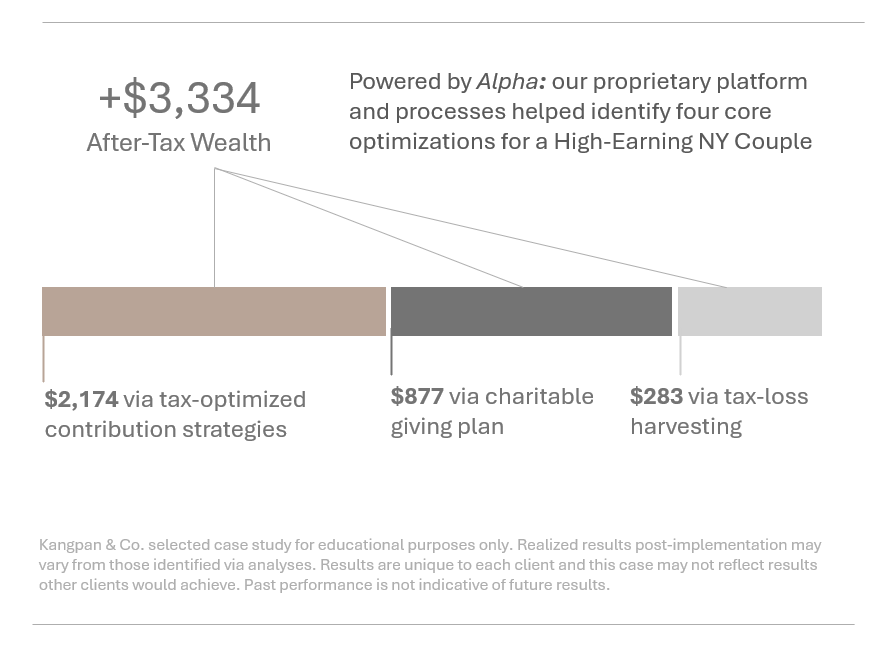
    • Saving for College Before the Stork Arrives: The couple are planning to but do not yet have children. Like many of us, they prioritize college savings in their long-term financial goals and were planning on opening a 529 Plan once they had children. Many couples are unaware that you can open 529 Plans before your kids are born to a) get a head start on saving but also b) start taking advantage of the tax benefits now. We modeled out the tax and long-term savings impact of our clients starting their 529 this year and also helped them set up and fund their account to begin taking advantage of all the tax benefits.
    • Health, Wealth, and a Triple-Tax Advantage: One of the clients has had an HSA for years into which their employer has been contributing $1,000 a year. However, the client had not been adding any additional funds since they felt they were young and healthy and had no need for putting funds into the HSA. We walked through the triple-tax advantages of HSAs and discussed how HSAs can function like an additional retirement account once they turned 65… when the funds could be tapped penalty-free for non-healthcare spending.
    • Maximizing Charitable Giving By Waiting for the New Year: Our clients donate to several charities each year. While the amounts are generous, they are not high enough for our clients to itemize. However, in 2026, the OBBBA tax changes will allow couples filing jointly to deduct up to $2,000 in qualified charitable cash donations, even if they take the standard deduction. Based on this change, we advised our clients to wait until at least Jan 1, 2026 to make some of their planned donations to take advantage of this new deduction policy.
    • Continuous Tax-Loss Harvesting: We identified and realized multiple tax-loss harvesting opportunities as we migrated the clients’ portfolios towards our recommended allocations. While many advisors only look at tax-loss harvesting once a year (if that), we implement it year round to continuously capture opportunities as they present themselves.

    These four optimizations alone added up to more than $3,334 in additional after-tax income that our clients will be able to build year after year. Note: this couple has graciously offered to serve as a reference for any of you reading this who are not yet clients.

    Food for Thought

    A collection of articles or books I’ve read since the last post that might be interesting to many of you.

    “Indeed, half of the worst drawdowns for traditional stock-bond portfolios occurred during inflationary episodes that triggered central bank rate hikes in the 1970s and 1980s — and most recently in 2022.”This is one of the reasons we advocate diversifying beyond stocks and bonds in your portfolios into alternative asset strategies like managed futures.”

    • The View from Ninety by Charles Handy: Handy spent his career writing and talking about organizational behavior and work-life balance. This is his final book and is mostly a quick, light philosophical musing for busy professionals running through the corporate grind. A key nugget in here for those of you questioning what else is out there:

    “… it’s very tempting to opt for ‘freedom from’ by pursuing a career that offers a fair guarantee of work and money for the rest of your working life. But then, like me, you will feel frustrated because really, secretly, you will want the ‘freedom to’ – the freedom to do what suits you better.”

    • One of Handy’s other books, the Elephant and the Flea, had a significant influence on me leaving the corporate world to start Kangpan & Co.

    Thank you for the continued partnership and for the opportunity to help steer your family’s capital toward what matters most.

    Nathan
    Founder & Lead Advisor

    Not a client yet? Subscribe to this bi-monthly client newsletter for free to see all the engineered tax, investing, and planning strategies we run for investors like you.

    Disclosures:

    This content is for educational purposes only and is not investment, tax, or legal advice. No post is an endorsement of any particular strategy or security. We do not receive any direct payments or commissions for securities discussed in our posts. Employees and clients of Kangpan & Co. may hold positions in securities discussed in posts. Speak with a licensed tax, legal, or financial advisor before making any changes to your investments or financial strategies. Past performance is no guarantee of future returns. Investing involves risk including the loss of capital.

    The case discussed in this post is a real-life client case study. The clients in this case study have agreed to be featured in Kangpan & Co.’s materials without any form of direct or indirect compensation. All results are specific to each individual client’s unique circumstances and may not be representative of results other clients would achieve.

  • Client Letter #1: Supporting Financial Literacy and Three Year-End Tax Optimizations

    Thank you for a wonderful 2025; why we donate to support financial literacy; three tax optimizations you should complete before the end of the year.

    To Our Friends and Valued Client Partners,

    I hope you get the chance to slow down and enjoy the holiday season with your loved ones as the year winds down.

    The close of the year is as good a time as any to kick off an official client newsletter. Moving forward, I’ll send these letters to keep you up to date on strategies and capabilities we’re developing between our planning sessions. I also hope these help serve as a valuable knowledge repository for future clients to learn about how we approach the financial world.

    This inaugural letter contains just two main topics:

    1. We Will Donate 5% of 2025 Profits to Philadelphia Financial Scholars
    2. Three Pre-End of Year Tax Optimizations to Keep In Mind

    I’ve loved working with each of you this year as we identify, optimize, and implement strategies aligned to your unique financial goals. Thank you for the wonderful partnership this year and I look forward to many more together.

    Happy Holidays from our family to yours,

    Nathan

    Topic #1: We Will Donate 5% of 2025 Profits to Philadelphia Financial Scholars

    Like many of you, I value education and want to support fair and equal access to quality programs. I have decided to focus specifically on supporting Financial Literacy because:

    • A basic understanding of personal financial management early on can change the entire course of someone’s life
    • Financial literacy is not part of the national education curriculum so it’s a topic that is widely misunderstood, particularly among underserved communities
    • As a wealth manager, financial literacy is a personal passion of mine (as any of you who have seen me excitedly pull up a chart or diagram in the middle of a meeting probably know all too well)

    Kangpan & Co. will donate 5% of 2025 profits to Philadelphia Financial Scholars, a “charitable organization that partners with schools to give students and families knowledge and confidence to achieve lasting financial empowerment.” Note, we do not have any formal affiliation with PFS at this time, we just like their mission.

    Topic #2: Three Pre-End-of-Year Tax Optimizations

    We’ve covered these strategies with most of you in your recent planning reviews, but just as a reminder, here are a few key tax planning strategies to be aware of as the year comes to a close:

    • 529 Plan Contributions: Most of you have until December 31 to make any tax-deductible contributions to your plans for calendar year 2025. We’ve discussed the tax benefits each of you qualifies for and have worked with many of you to complete your contributions for the year already. Reach out to us if you want to make any last minute updates or changes to your strategy.
    • Charitable Giving: OBBBA changes to the tax code next year allow for up to $2,000 in qualified charitable cash donations in 2026 to be deducted from your taxes, even if you are taking the standard deduction. That means it could be tax-beneficial for some of you to wait until Jan 1st for your holiday season cash donations. I’m sure many of you agree with us that Charitable Giving shouldn’t just be about the tax savings, but taking advantage of this tax benefit means you will be increasing your giving power to the causes you care about.
      • We also wrote a piece earlier in the year on our blog about advanced charitable giving via donating appreciated stock that you can check out here
    • Tax-Loss Harvesting: We continuously manage, and then report on tax-loss harvesting throughout the year for any accounts we directly manage for you. This is just a reminder for those of you with any accounts we don’t directly oversee to complete your tax-loss harvesting before the end of the year. Reach out to us if you want help or guidance with this.

    If You’re Not a Client Partner Yet…

    Kangpan & Co. is a comprehensive wealth manager using proprietary technology and analytics to identify and implement high value tax, planning, and investment strategies that other advisors and approaches overlook. We partner with high-earning and high net worth professionals that want their finances functioning at peak efficiency.

    Not a client yet? Subscribe to our bi-monthly client newsletter for free to see all the engineered tax, investing, and planning strategies we run for investors like you.

    Disclosures: This content is for educational purposes only and is not investment, tax, or legal advice. No post is an endorsement of any particular strategy or security. We do not receive any direct payments or commissions for securities discussed in our posts. Employees and clients of Kangpan & Co. may hold positions in securities discussed in posts. Speak with a licensed tax, legal, or financial advisor before making any changes to your investments or financial strategies. Past performance is no guarantee of future returns. Investing involves risk including the loss of capital.