Category: Client Letters

  • Private Real Estate Funds: Tax Benefits, Income, and What to Watch Out For

    If you’re trying to live off portfolio income, you need to bring together stable, after-tax income from diversified sources. And very few asset classes look better on paper for this purpose than mature, cash-flowing real estate properties.

    I’ve always wanted to own a broadly diversified real estate portfolio for the predictable, monthly income. But, as Sheila can attest to, my handyman skills don’t extend much beyond putting together Ikea furniture and hanging the paintings we find antiquing. 

    Enter Private Real Estate Funds.

    In this primer we’ll cover:

    • What is a Private Real Estate Fund?
    • The three key benefits they can bring to a portfolio
    • The downsides of this asset class

    What is a Private Real Estate fund?

    As the name implies, Private Real Estate funds are investment vehicles that primarily invest in… real estate. This could be any type of real estate from multi-family housing to data centers. 

    Since the underlying assets are physical properties charging rent, returns from these funds typically include a meaningful dividend yield as well as underlying appreciation of the assets over time. 

    These funds are typically managed by an outside investor who charges a fee for sourcing and managing the underlying investments. Private funds are not traded on stock exchanges but can be purchased through certain financial advisors. The partnerships we’ve developed ensure clients of Kangpan & Co. have access to many of the same institutional funds that the private investment arms of large banks do. 

    Before we dig into the characteristics that make Private Real Estate funds a core component of the Personal Endowment investment portfolio, I need to note that these funds are generally for accredited investors as defined by the SEC. This post is for educational purposes only and is not an investment recommendation or endorsement of anything specific strategy or fund. Kangpan & Co. is a fee-only RIA, we do not accept commissions or any other form of compensation from fund providers. We like our recommendations to clients to be free from conflicts of interest.

    Now let’s get to three ways these funds can benefit a portfolio.

    Benefit 1: Diversification vs. Other Core Assets

    If you’re trying to build a portfolio that generates income across different types of economic environments, you need genuine diversification. Investments need to have returns with low long-term correlations to each other so that when a shock hits, your entire portfolio doesn’t move in the same direction at once.

    This is the canonical argument for holding both stocks and bonds. But as 2022 demonstrated clearly, a two-asset portfolio has real limits. When inflation drove interest rates sharply higher, both stocks and bonds fell simultaneously, leaving portfolios that assumed low correlation between the two with nowhere to hide. 

    Private real estate has historically shown low correlation to both public equities and fixed income. According to an analysis from CAIS, private real estate returns have had a correlation of approximately 0.11 to the S&P 500 and -0.28 to the Bloomberg Aggregate Bond Index over a recent 15-year period.
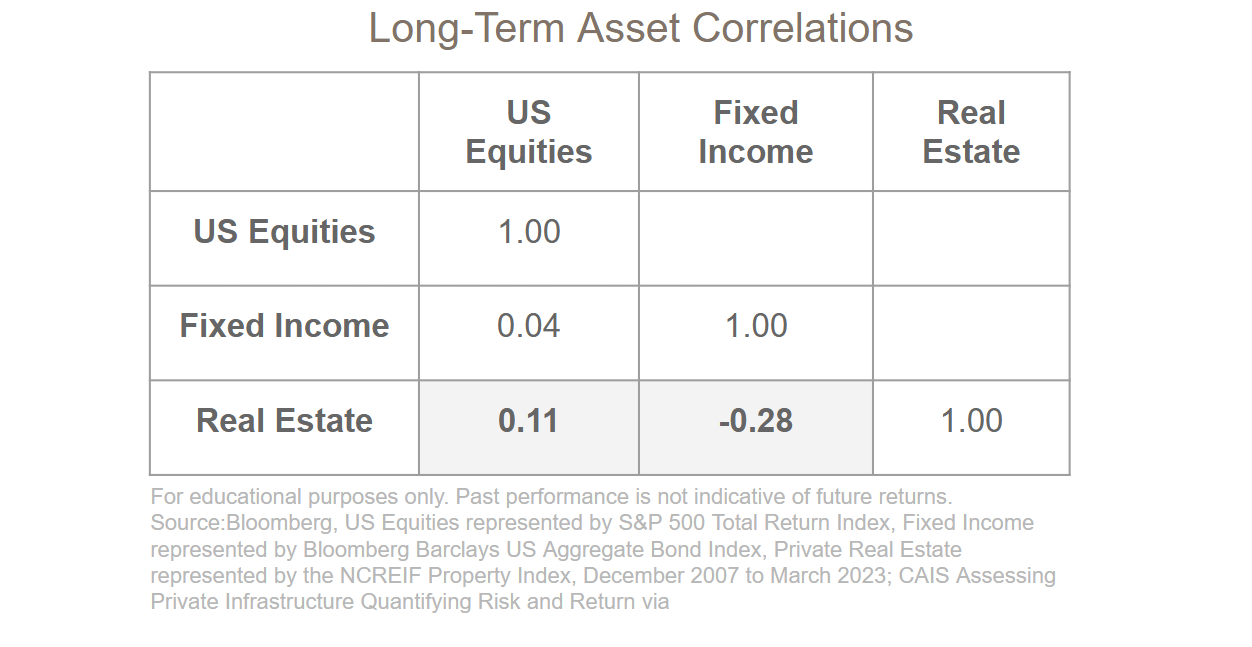
    The economic drivers of real estate returns – rental income, occupancy rates, property values – respond to different forces than corporate earnings or interest rate movements, even if they’re not entirely immune to macro conditions. 

    This doesn’t mean private real estate is uncorrelated to everything all the time. A severe recession can affect private real estate too. But adding it to a portfolio of dividend equities and fixed income creates a third set of return drivers (which is the point). 

    Our Personal Endowment portfolios incorporate real estate positions by default as well as additional asset classes to further diversify income sources.

    Benefit 2: Tax-Deferred Income

    Much like an individual investing directly in an apartment building, certain non-cash expenses like depreciation are deducted from the income generated by properties owned by private real estate funds. 

    These deductions get wrapped into what’s known as Return of Capital, or ROC. ROC distributions aren’t taxed as current income. Instead they reduce the cost basis of your investment over time, deferring the tax liability until you eventually sell. Potentially at lower long-term capital gains rates rather than ordinary income rates.

    For someone living off portfolio income, or for anyone in a meaningful tax bracket, this distinction is significant. 

    Here’s how this works in practice.

    Let’s say you’re in the 35% federal tax bracket and pay state taxes of 5.0%. We’ll ignore NIIT and local taxes for now to keep things simple.

    Scenario 1: You have $300k in a taxable corporate bond fund that yields 4.5%. 

    • $300k * 4.5% yield = $13,500 in pre-tax income
    • $13,500 * 40% combined tax rate = ~$5,400 in taxes
    • Leaving you with $8,100 after-tax income

    Scenario 2: Let’s look at the same math with a Private Real Estate fund that also yields 4.5% but 80% of it categorized as ROC.

    • $300k * 4.5% yield = $13,500 in pre-tax income
    • $13,500 * (1-80% ROC) = $2,700 in taxable income
    • $2,700 taxable income *  40% tax rate = $1,080 in taxes
    • Leaving you with $12,420 after-tax income

    Same yield. Same tax bracket. $4,320 more in your pocket annually simply from how the income is classified. On $300,000 that’s a 53% improvement in after-tax income from a single asset class. 

    Keep in mind, this example was only looking at the yield of a private real estate fund and not underlying appreciation of the fund’s properties which can add even more to the total return over time.

    ROC can range significantly between funds and shouldn’t be the primary lever you look for when evaluating options. That said, we always look at ROC for funds within our Personal Endowment portfolios since we use these strategies to optimize after-tax income for our clients.

    If you’re wondering how much of your current portfolio income is being unnecessarily eroded by taxes, this is one of the first things we look at in our Personal Endowment review. Contact us or schedule a complimentary consultation if you want us to audit your current situation.

    Benefit 3: Reduced Volatility via Appraisal-Based Pricing

    Public stocks and bonds are priced continuously by the market. Every piece of news, every Fed statement, every earnings miss moves the price in real time – often dramatically and in ways disconnected from the underlying business fundamentals.

    Private real estate funds are generally valued quarterly through formal appraisals by standardized internal pricing models and independent valuators. The inputs are things like rental income, occupancy rates, cap rates, and comparable property transactions – not sentiment, momentum, or a Twitter thread about interest rates.

    What this means practically is that the reported value of your private real estate allocation moves more slowly and in response to genuine changes in the underlying properties. This has the effect of dampening the day to day swings in your portfolio.

    It’s important to clarify, appraisal-based pricing doesn’t mean you’re getting a better deal than the market would offer. It just means the price reflects a fundamental assessment of the asset rather than a real-time market clearing price.  The valuation of a private real estate fund could be lower or higher than publicly traded REIT equivalents depending on current market sentiment.

    What are the risks of Private Real Estate Funds?

    No asset class is without tradeoffs, and private real estate funds have specific ones worth understanding clearly before investing.

    Gated redemptions: Unlike a stock or ETF you can sell tomorrow, private real estate funds typically have strict limits on when and how much you can redeem. Most funds allow redemption on a quarterly basis with meaningful advance notice requirements, and during periods of market stress funds can gate redemptions entirely. Meaning you cannot access all your original capital regardless of how much you need it in the moment. This is the illiquidity premium at work. You earn higher after-tax income in part because you’re accepting that the capital is not freely accessible. For anyone investing in these funds the capital should be genuinely long-term, money you don’t need to touch for five to seven years minimum.

    Manager Quality and Fees: In a public index fund the manager is largely irrelevant — you’re buying the market. In private real estate, the manager’s skill at sourcing deals, managing properties, and timing the cycle determines a significant portion of your return. And the managers get paid to do this work. Private fund fees can be meaningful, typically 1% to 1.5% in management fees plus performance incentives. Private funds need to be evaluated against the net return of fees they deliver rather than the topline gross return marketing materials may highlight. We evaluate our funds carefully before recommending them and access institutional share classes where available to minimize fee drag.

    Valuation Opacity: Quarterly appraisals reduce volatility but also mean you have limited visibility into what your investment would actually fetch in a sale at any given moment. The reported value of a private real estate fund should be treated as an estimate rather than a market price. Some funds report when they sell their underlying assets and comparing the market price they receive for their assets vs. the underlying valuation can be a good way to check the fund’s homework.

    The Bottom Line

    Private real estate funds are not right for every client or every dollar. They require genuine long-term capital, tolerance for illiquidity, and access to institutional-quality managers. Which is why they remain largely unavailable to retail investors outside of advisor relationships.

    For accredited clients that want portfolio diversification and tax-deferred income streams, we feel private real estate funds earn their place. This is particularly the case for accredited investors that want to build a Personal Endowment style portfolio – the tax efficiency, the income stability, and the diversification against public market volatility all serve the core goal: durable, growing income that doesn’t require selling principal.

    If you’re building towards a life fueled by portfolio income and want to understand how private real estate fits into your specific situation, contact us or book a complimentary consultation.

    Not ready to talk yet? Every letter in this series goes deeper into how the Personal Endowment works – subscribe to get them directly.

    Food for Thought

    • The Historical Benefits of US Private Real Estate via Invesco: A deeper look at how US Private Real Estate as an overall asset class has performed over time vs. stock and bonds
    • Is it Better to Rent or Buy via The Economist: Buying a home doesn’t always come out ahead financially vs. renting long term. It all depends on interest rates, rent levels, etc. At the end of the day, even if the math doesn’t work out, owning the home you raise your family in has emotional benefits that far outweigh what the numbers say either way.

    Thank you for being part of our community – whether you’re a client, a reader, or somewhere in between. If this letter resonated with your own situation, I’d genuinely enjoy hearing about it.

    Nathan
    Founder & Lead Advisor

    Disclosures: This content is for educational purposes only and is not investment, tax, or legal advice. No post is an endorsement of any particular strategy or security. We do not receive any direct payments or commissions for securities discussed in our posts. Private funds are generally available only to ‘Accredited Investors’ as defined by the SEC. The Personal Endowment is a conceptual investment framework customized to each client and does not represent a specific fund or guaranteed outcome. Employees and clients of Kangpan & Co. may hold positions in securities discussed in posts. Speak with a licensed tax, legal, or financial advisor before making any changes to your investments or financial strategies. Past performance is no guarantee of future returns. Investing involves risk including the loss of capital.

  • Letter# 8: What Everything Costs in Portfolio Terms

    Dear Friends,

    When we were looking for our family home during late 2020, our realtor tried to convince us to look for homes $300k above the price point we were shopping for because mortgage rates were so low. His logic was that the extra $1,000-$1,500 a month weren’t meaningful in the context of a C-level career.

    That would be the case if I were thinking just about the income I was making from my job. But I was already thinking about everything in terms of portfolio income tradeoffs in 2020.

    Sheila had already left her job in advertising to focus on raising our children. So the calculation for how we would make this work if we were going to be fully living off income from a portfolio went like this:

    • $1,000 a month is $12,000 a year in additional yearly mortgage payments (before corresponding property tax, insurance, and maintenance increases)
    • $12,000 a year means another $300,000 I would need to build up in my portfolio if I was going to live off 4% a year in income distributions
    • Saving up an $300,000 could mean an additional year of working

    We decided not to go for the homes that cost an extra $300k.

    Now, we have what we think is a very nice home but Ryan Serhant isn’t about to come knocking on our door to do a video tour. I would call it reasonable luxury, not egregious ostentation. 

    If you’re trying to become financially independent, you don’t have to be Spartan about everything in life but you do need to be intentional with the big decisions. 

    The nondiscretionary expenses are what really matter. Housing, cars, education, etc. These fixed costs are the baseline for what your portfolio income needs to cover.  

    If you’re trying to become financially independent, it’s critical to think about these major expenses in terms of what size portfolio can support the incremental costs and how long it will take you to build that portfolio. 

    Housing is the biggest fixed cost most families carry. But it’s not the only one that can have a significant impact on portfolio income calculations. Let’s talk about education. Specifically K-12 education. 

    Like many of you, education is important to us. We specifically picked a school district that had a very strong K-12 public school system. There were two layers of decisions that went into this.

    • First, we both went to public schools growing up and we wanted our kids to have a similar experience
    • Second, we also knew private school was not something we wanted to have to pay for

    We didn’t have kids in 2020, but knew we wanted to end up with at least two (which is exactly where we’ve landed since). 

    In a good public school system, we could expect to pay somewhere around $5-10k a year in school taxes which would cover K-12 for our children.

    If the school system was lacking and we had to go to private school, that could easily end up being $60k+ for two kids.

    That $50k-55k difference translates to at least an incremental portfolio of $1.25M assuming a 4% rate of income distributions. This could mean another 3-4 years of work to build up. I love my children and would gladly work any job as long as I needed to in order to support them and make sure they got a good education.

    But why do it if I don’t have to? It’s much easier to land in a good public school district in the first place. 

    This is just how we thought about education for our family. Education is a deeply personal thing and there may be other reasons such as religion, specific values, etc. for why you want to send your children to private school. 

    Affording private school is one of the most common issues I discuss with mid-career professionals and an important component of how quickly someone can reach financial independence.

    These kinds of life vs. portfolio tradeoffs and income planning scenarios are a core part of the Personal Endowment strategy I work on with clients. The income-centric portfolio is just the fuel that supports the intentional life that we design together. 

    If you’re in the middle of decisions like these and haven’t mapped what they mean for your transition timeline, that’s exactly the conversation I have with clients. I’m happy to run high level numbers with you.  Feel free to reach out for a complimentary 30-minute consultation if you’re thinking about these things.

    Food for Thought

    • Your Money or Your Life by Vicki Robin: The foundational book on understanding the real cost of major life decisions — not in dollars but in the hours of your life required to earn them. Most contemporary thinking on intentional living and financial independence traces back to this.
    • How Financial Independence Can Quietly Shrink Your World by Jordan Grumet: Jordan is an MD who achieved financial independence and writes about the philosophical dimensions of this lifestyle on his Substack, The Purpose Code. This is a piece about the perils of focusing too much on trying to reduce costs to reach financial independence rather than being intentional about the life your portfolio is meant to fund.

    Thank you for being part of our community – whether you’re a client, a reader, or somewhere in between. If this letter resonated with your own situation, I’d genuinely enjoy hearing about it.

    Nathan
    Founder & Lead Advisor

    Sign up for our letters: Our twice-monthly letters break down strategies we develop for our clients who are generally mid-career professionals with $1M to $20M in assets that have outgrown standard retail advice. See how we’re engineering our HNW clients’ capital to match the lifestyles they want.
    Sign up here

    Disclosures: This content is for educational purposes only and is not investment, tax, or legal advice. No post is an endorsement of any particular strategy or security. We do not receive any direct payments or commissions for securities discussed in our posts. The Personal Endowment is a conceptual investment framework customized to each client and does not represent a specific fund or guaranteed outcome. Employees and clients of Kangpan & Co. may hold positions in securities discussed in posts. Speak with a licensed tax, legal, or financial advisor before making any changes to your investments or financial strategies. Past performance is no guarantee of future returns. Investing involves risk including the loss of capital.

  • Client Letter #7: When Six-Figure Incomes Don’t Feel Like Enough for Private School

    Private real estate investments, when high earners don’t know if they can afford private school, a primer on infrastructure investing, Hu Anyan’s I Deliver Parcels in Beijing

    Dear Friends,

    The most common financial anxiety I encounter has nothing to do with how much someone earns.

    Whether a family is making $300,000 a year or clearing seven figures, the worry is almost always the same: can we afford the life we want without quietly trading away the future we’re building toward?

    One question that keeps surfacing — especially among families with school-age children — is whether private K-12 education can realistically fit into the budget without compromising long term goals. That’s what today’s deep dive addresses.

    But first, a quick update on how we’re incorporating private investments into client portfolios.

    Firm Updates

    Investing: Private Real Estate

    We’ve started incorporating private real estate funds into client portfolios. As I mentioned in Client Letter #5, we have developed a partnership with a leading private fund platform that works with independent wealth managers to provide access to the same institutional private equity, real estate, infrastructure, and credit funds as the largest banks and brokerages.

    The difference is they bring a level of fees, investment minimums, transparency, and operational processes that I feel good about using for my own family’s private fund needs – which means I feel good about bringing them to clients.

    I have been impressed with what I have seen from them so far and will be sharing my findings and recommendations with those of you who are accredited investors during our upcoming quarterly reviews.

    As a reminder, unlike many other advisory firms, we are a fee-only fiduciary. We do not accept third party commissions or payments for the services or investments we recommend. We want our clients to feel confident when we recommend a strategy or fund that we have no hidden incentives in doing so.

    Deep Dive

    Making K-12 Private School Work

    These middle years can be tough. You need to balance your career with the demands of caring for young children, and in many cases, for aging parents.

    You’ve had a lot of professional success but costs are adding up and you’re not sure if your mid to high six-figure family income is enough to provide the life you want for your family today while still making sure you’re not robbing yourself of your future goals.

    We have two young children and I’ll be 40 in two months so I’m intimately familiar with what many of you are going through.

    One item that has come up repeatedly in conversations with mid-career professionals is the enormous cost of private school for the K-12 years. Even C-Level executives at mid-sized firms and doctors are struggling to come up with the $100,000+ per year it takes to put three kids through private school while also paying for the mortgage, family vacations, and day-to-day life in a high cost-of-living city.

    Figuring out how to make the yearly budget accommodate school tuition is a painful but relatively straight-forward exercise for this group. However, the most common question I get is whether paying for school now is going to significantly impact retirement in the future.

    How Much Will Spending Tens of Thousands on Private School for the Next Decade Impact My Retirement?

    The wealth management industry has done a good job educating people on the need to aggressively contribute funds to retirement throughout their entire career. This is sound advice for the average household making the median income throughout their lives.

    But some of this is manufactured fear created by an industry that makes money off of how much people keep in their accounts – not when people choose to spend their money intentionally on the things that are important to them.

    Many of our clients have been aggressive both in their careers and in putting excess funds towards retirement and other investments. They are lucky enough to already have seven figures saved up by the time they come to the end of their 30s. Our financial planning algorithms show that for these people, putting more money towards retirement is a nice to have, not a necessity, to live the retired life they want in the future.

    Here’s an example.

    • You and your spouse have both worked high paying jobs since graduating.
    • You’re both around 40 years old and already have $2,000,000 saved up across your retirement and investment accounts.
    • You have three kids you want to put in private school but that would mean not being able to contribute nearly as much to your savings and investments as you have been.

    Even if you never contributed to these funds again, your nest egg could be worth just a bit over $13.6 million by the time you retire at 65 (assuming a moderately aggressive allocation that returns 8.0% a year).

    Whether $13.6 million is enough to retire on depends on your ultimate goals and what you want your lifestyle to be. But using the simplified 4% rule of retirement, those assets could support a yearly retirement spend of $544,000.

    In this situation, you can likely focus on providing the education and lifestyle you want for your family now while knowing time is going to do a lot of heavy lifting on the assets you’ve already built.

    This is where having a solid idea of what you want your future lifestyle to be can better define the tradeoffs you might be making today.

    Making Private School Payments Slightly Less Painful

    There are a few ways to reduce out-of-pocket private school costs for high-earners. Note, these can vary significantly based on state and school policies:

    • Using a 529 as a tax-advantaged K-12 private tuition payment account
    • Paying tuition upfront
    • SBLOCs or other specialized loan vehicles

    I. Using 529 as a tax-advantaged payment account

    As of January 1st 2026, parents can now use up to $20,000 a year per student in 529 Plan funds to pay for K-12 tuition expenses without Federal penalties.

    But the real benefits come at the state level due to state tax deductions. Because there are generally no time restrictions on how long funds need to be in a 529 before being used for qualified expenses, you can effectively use your 529 Plan as a state tax deductible payment account for your K-12 tuition.

    Each state has different rules but let’s look at Pennsylvania as an example. In PA, a married couple can contribute up to $38,000 a year per beneficiary per 529 plan. PA has a flat state income tax rate of 3.07%.

    Let’s say you have two kids in private school and you’re paying $30k a year for each of them. Here’s how your 529 Plan could generate up to $1,228 in yearly “savings” on your tuition payments:

    • Contribute Tuition Funds to the 529: Instead of paying your tuition out of your bank account, first contribute up to $20k each school year into each child’s 529 Plan. Remember, $20k is the federal limit for using 529 funds for K-12 expenses without penalties.
    • Pay the Tuition Out of the 529: Pay the tuition out of your 529 Plan.
    • Get you state tax deduction: Since the $20k contribution to the 529 is state tax deductible, you will get a state tax deduction worth $614 ($20k * 3.07% PA state tax rate) for a combined $1,228 between your two children.

    This isn’t life changing by any means, but every bit helps when you’re in the squeeze years of trying to pay for school, your mortgage(s), and day-to-day living expenses. You are saving $1,228 by paying tuition that you would have paid anyway.

    If you’re a client using our managed services, we will handle most of these steps for you, including letting your accountant know to properly file each of these items.

    If you’re doing this on your own, make sure you coordinate with your accountant or other tax advisor on all of these steps and check your state tax code. Every state has different rules for how / if 529 funds can be used for K-12 expenses.

    II. Paying Tuition Upfront

    Some schools offer small discounts for paying tuition upfront vs. paying throughout the year. This is typically 2-3% but depends on your school’s specific policies. In some cases you need to specifically ask for or negotiate a discount for upfront payment.

    Some people may see the 2-3% as being lower than what you could get in a high yield savings account or money market fund at this time and be tempted to try and squeeze out an extra percentage or two.

    For example, if your tuition is $30,000 you might look at something like this:

    • 2.5% discount on $30,000 paid now = $750 in tuition savings
    • $30,000 invested at 3.5% in a High Yield Savings Account = $1,050 in potential yearly interest if I pay tuition throughout the year

    If you’re doing a calculation like this, you need to keep in mind the after-tax impact of your strategies.

    In the first scenario, your $750 in tuition savings goes straight to your bottom line.

    If you’re a high earner (which you likely are if you have kids in $30k / yr private school), then your $1,050 could be subject to federal, state, and local taxes which could add up to well over 45%. Your $1,050 in interest ends up being $567 after 45% taxes.

    III. SBLOCs or Other Specialized Loan Vehicles

    Depending on current rates and your broader personal risk tolerance, net worth, and cashflow profile, you may be able to fund your private school needs through various loans with favorable rates relative to the rest of your financial assets. Higher net worth families have options available to them that go beyond educational loans such as borrowing against investment accounts, home equity, etc.

    This is a nuanced, complex topic that we won’t be able to fully cover in a newsletter. We can work with any of you who are interested in this to understand the tradeoffs and how it may impact your broader financial plans.

    Private Consultation: We advise our clients on education strategies as part of their broader financial planning. If you’re not a client but would like someone to help you understand the short and long-term financial tradeoffs of sending your kids to private school, you can schedule a complimentary 30-minute session with me. We waive fees for newsletter subscribers for any initial consultations.
    Schedule a consultation

    Food for Thought

    A collection of articles or books I’ve read that might be interesting to many of you.

    • Assessing Private Infrastructure via CAIS: We’ve started incorporating private real assets into client portfolios and came across this piece during our research into the risks and potential benefits of private infrastructure funds. As CAIS notes:

    “Private infrastructure funds, in aggregate, have demonstrated a low correlation to public equities and fixed income, while maintaining a moderate correlation to private real estate. They also had smaller drawdowns than public equities, perhaps most significantly following the 2022 Fed rate hikes.”

    • I Deliver Parcels in Beijing by Anyan Hu: I kept coming across this book in various “Best of 2025” lists from the Financial Times, Economist, etc. I agree with the sentiment, it’s one of the best books I’ve read in the past year. It’s a first person account of what it’s been like working in China over the past 10-15 years as a cog in the vast machinery of the platform companies. It’s both an informative look at how Chinese companies operate and an interesting meditation on the purpose and meaning of work in one’s life.

    Thank you for the continued partnership and for the opportunity to help steer your family’s capital toward what matters most.

    Nathan
    Founder & Lead Advisor

    Not a client yet? 

    Join the Briefings: Our twice-monthly letters break down strategies we develop for our clients who are generally mid-career professionals with $1M to $20M in assets that have outgrown standard retail advice. See how we’re engineering our HNW clients’ capital to match the lifestyles they want.
    Sign up here

    Disclosures: This content is for educational purposes only and is not investment, tax, or legal advice. No post is an endorsement of any particular strategy or security. We do not receive any direct payments or commissions for securities discussed in our posts. Private funds are illiquid, speculative, and carry higher fees. Private funds are generally available only to ‘Accredited Investors’ as defined by the SEC. Employees and clients of Kangpan & Co. may hold positions in securities discussed in posts. Speak with a licensed tax, legal, or financial advisor before making any changes to your investments or financial strategies. Past performance is no guarantee of future returns. Investing involves risk including the loss of capital.

  • Client Letter #5: The Opportunity Costs of Over-Saving

    Incorporating Private Assets into our strategies, Bitcoin as a portfolio hedge, the problem with not knowing how much is enough, concentrated stock positions, 1929

    Dear Friends and Client Partners,


    In this week’s Deep Dive we’ll talk about how to avoid the unintentional consequences of staying in a job for the paycheck when you already have enough to move on to something you’re more passionate about.

    But first, a quick announcement that I’m particularly excited about for Kangpan & Co. clients.

    Firm Updates

    Partnerships: Institutional Private Market Access

    We secured a partnership with a premier provider of private fund access, specifically designed for independent wealth firms. For clients who meet Accredited Investor standards, this provides a streamlined path into institutional-grade Private Credit, Private Equity, and Real Estate—asset classes that have traditionally been the domain of the world’s largest endowments and family offices. We will be discussing these options with eligible clients in the coming months to determine how private market exposure may complement your current strategy and to review the specific tradeoffs, such as illiquidity and diversification benefits.

    Research: Bitcoin as a Portfolio Hedge?

    We get lots of questions on whether Bitcoin can act as a hedge against equity volatility. Our recent analysis shows the opposite: it’s increasingly acting as a high-beta equity proxy.

    Deep Dive

    The Problem with Not Knowing How Much is Enough

    When I was getting licensed as a wealth manager, I assumed my primary value to clients would be technical: optimizing asset class returns or uncovering marginal tax savings. That’s why we use all kinds of sophisticated systems at Kangpan & Co. to model expected returns, run Monte Carlo simulations, and forecast dynamic withdrawal bands.

    However, these tools can’t answer the truly fundamental questions like:
    What are you saving for

    The more people I sit down with, the more I realize my most valuable work is helping clients bring clarity to their vision for their future lives. 

    Most people I meet with are saving and investing for a desirable but vaguely defined future. It’s usually “early retirement” or a “second act that is more aligned to long-term values.” 

    But the planning usually stops short of quantifiable specifics. Important details remain unanswered or only loosely defined.

    Are you going to keep living in the same high cost of living suburbs that you raised your family in? Do you want to maintain your current lifestyle or enhance it? Are you going to sell the business you’ve built or transition it to the next generation and live off its distributions? 

    You need to understand what your dream life will actually cost to live. If you don’t know what you’re specifically aiming for, you’ll have no idea if you’re even pointed in the right direction.

    Advisors often talk about the risk of not saving enough for retirement… which can be a problem. But it’s a pretty well-understood one.

    There is an equally problematic issue that’s not talked about enough: over-saving. 

    It’s very easy to get caught up in the momentum of the day-to-day and forget what your actual long-term goals for your life are. So you keep working and grinding and saving up more and more. You end up spending years longer than you needed to working in a job that you’re not passionate about that’s slowly eroding the most valuable asset you have, the rest of your life.

    You often need far less than you think to step away from what you’re doing today to start that next phase of your life. Some of my most rewarding work so far has been helping people realize they are much closer to financial independence than they imagined.

    The key to this assessment isn’t a complex investment product. It is the process of crystallizing and quantifying your goals. Once defined, we can engineer a personalized Playbook to reach—or even accelerate—that timeline. 

    This is exactly what I did for myself. I sat down in my early 30s and thought deeply about what I wanted from life and then iteratively built a personal Playbook to ensure I was able reach my goals before 40. 

    I focused on three quantifiable requirements:

    • A home Sheila and I both loved that our family could grow into with excellent K-12 public schools
    • The ability to go out to different restaurants in the area at least once a week as a family (and there is no shortage of places to try in the Philly area)
    • Going on three to four nice vacations together each year

    Beyond the numbers, I wanted a post-corporate work life defined by three types of independence:

    • Financial independence to build Kangpan & Co. intentionally, choosing only the clients I am best suited to serve
    • Schedule independence to ensure I never miss the important moments in the lives of my family and loved ones
    • Moral independence to ensure there are no conflicts of interest or compensatory arrangements that sacrifice the objectivity of the advice I provide to clients

    Making steady progress against these specific goals over the years allowed me to “retire” from a C-level role before 40. Each month I spent 30-minutes review my Playbook to ensure our costs, savings, and investments were on pace to meet these quantified goals. 

    Once I hit my target numbers, I shifted my portfolio towards an all-weather, multi-income investment strategy that would support my family’s financial needs in perpetuity. I then started the next phase of my life. 

    I increasingly think effective wealth management boils down to this:

    Envision the life you want and engineer your finances to make it a reality.

    That’s what I did for my own family and that’s what I love doing for the families I serve. This ethos is the foundation of Kangpan & Co.’s Personal Endowment framework that I’m steadily building to support our client base.

    If you aren’t a client yet but want a thought partner to help you quantify your vision for a more intentional financial future and engineer the strategies to get there, feel free to reach out.

    Food for Thought

    A collection of articles or books I’ve read that might be interesting to many of you.

    “Although continuing to hold a concentrated stock might seem like a status-quo stance, it is, in fact, one of the most risky investment strategies an investor could pursue, and it is especially problematic for those wealth creators who seek to become guardians of wealth for themselves and their families… Bessembinder (2018) shows that, during the 1926–2016 period, for all the 25,967 common stocks in the Center for Research in Securities Prices (CRSP) database, by far the most frequent one-decade buy-and-hold return is -100%.”

    • 1929 by Andrew Ross Sorkin: The first part of the book examines the build up to the crash of 1929 that led to the Great Depression. It’s a fascinating mirror of many of the same dynamics we’re seeing in markets today. I personally wasn’t a fan of the last third of the book focusing so heavily on the nuances behind the passage of the Glass-Steagall act but the entire book is highly readable for such a heavy topic.

    Thank you for the continued partnership and for the opportunity to help steer your family’s capital toward what matters most.

    Nathan
    Founder & Lead Advisor

    Not a client yet? 

    Subscribe to this bi-monthly client update for free to see all the engineered tax, investing, and planning strategies we run for high-earning and high net worth investors like you.

    Or reach out to us to get a complimentary, 30-minute Diagnostic to see what tax, investing, and planning opportunities your current strategy or advisor is overlooking.

    Disclosures: This content is for educational purposes only and is not investment, tax, or legal advice. No post is an endorsement of any particular strategy or security. The Personal Endowment is a conceptual investment framework customized to each client and does not represent a specific fund or guaranteed outcome. Asset allocation and yield targets are subject to market volatility. We do not receive any direct payments or commissions for securities discussed in our posts. Employees and clients of Kangpan & Co. may hold positions in securities discussed in posts. Speak with a licensed tax, legal, or financial advisor before making any changes to your investments or financial strategies. Past performance is no guarantee of future returns. Investing involves risk including the loss of capital.