Tag: 529

  • 529 Plan Diagnostic Details

    This post details our approach to optimizing a client’s college savings strategy using a Diagnostic. Check out our primer posts on Systematic Optimization and Diagnostics to learn more about our unique approach to financial advisory .

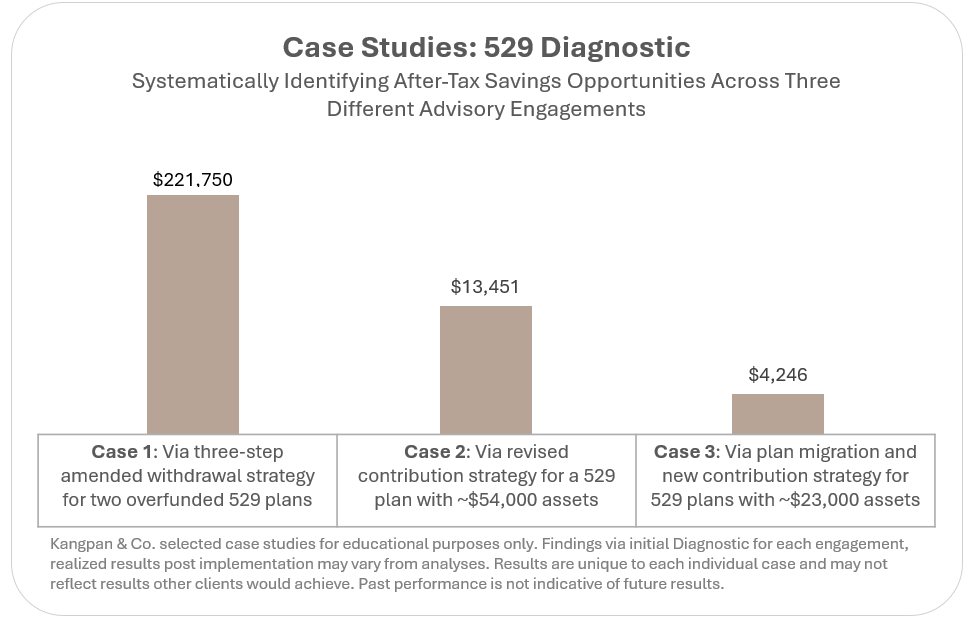
    It’s common to wonder whether you’re saving enough for your children’s educational needs and to also be unsure what the tradeoffs are to being underfunded vs. overfunded. Our 529 Plan Diagnostic is designed to quickly give clear answers to these and other common questions while enabling us to provide a comprehensive, tailored recommendation for improving your overall approach to college savings.

    As with all our Diagnostics, this structured approach ensures we are comprehensively examining your situation in a methodical way, quantifying the tradeoffs that matter, and then aligning your path forward to your unique goals. Our Diagnostics evolve over time as we identify additional analyses and Systematic Optimizations through our ongoing research and work with clients.
    Sample Analysis
    See what a deliverable looks like via a blinded detailed 529 analysis here.

    The 529 Diagnostic

    Our 529 Diagnostic currently contains five primary Systematic Optimizations supported by 12 detailed analyses as shown in the table below. All analyses and recommendations are provided to the client as part of our deliverable.

    Table 1: Our 529 Plan Optimization Diagnostic as of October 2025

    Systematic OptimizationsSupporting Analyses
    01: Optimize contribution strategy to reach target educational funding needs– Quantify the expected future cost of college
    – Model expected % of costs funded by plan based on current value of account(s) and contribution strategy
    – Calculate revised contribution strategy necessary to reach target funding %
    02: Define optimal investment allocation path to funding educational needs – Define target equity / bond mix by each investment year
    – Identify which funds to use within the specific 529 plan to implement the investment strategy
    03: Optimize 529 tax and funding benefits– Quantify the incremental tax benefits of using 529 plan to save for college costs
    – Balance tax benefits with potential costs of being overfunded and other opportunity costs
    04: Determine which state’s 529 plan is optimal– Calculate current plan costs vs. tax benefits
    – Compare against other state plans to identify opportunities for total cost improvements
    05: Develop mitigation strategy to minimize costs of being overfunded (if plan will be overfunded) – Quantify the incremental costs of being overfunded
    – Reduce costs through direct mitigation (i.e. Roth Rollover, Beneficiary Updates)
    – Further reduce costs through tax rate management

    Client Implementation

    This Diagnostic is available to our financial planning clients as part of their ongoing deep dives or can be purchased as a standalone, flat-fee project. Email us if you’d like to discuss anything in more detail or learn more about our services.

    email: [email protected]

    Disclosures:
    This content is for educational purposes only and is not an investment recommendation. Employees and clients of Kangpan & Co. may hold positions in securities discussed in this post. Speak with a licensed financial advisor before making any changes to your investments. Past performance is no guarantee of future returns. Investing involves risk including the loss of capital.

  • Why New Jersey High-Earners Might Want to Move Their 529 Plan

    Tax benefits are the primary reason many investors open 529 plans to save for education expenses. These mainly come in the form of:

    • Deferred taxes on the dividends, distributions, and growth of investments within the plan
    • Tax deductions from contributions made to the plan

    The availability of, and rules for tax deductions from contributions vary significantly by your state of residence. We’ll be taking a look at the rules of a high-earner in New Jersey for this discussion.

    High Earners May Not Be Eligible for State Tax Benefits

    In New Jersey, up to $10,000 a year of 529 plan contributions are deductible from state taxes for residents contributing to the New Jersey 529 plan. However, this deduction is only available for those with a gross income of $200,000 or less.

    That means if you’re a New Jersey resident who is fortunate enough to earn $200,000 a year or more, then you unfortunately do not get the benefit of the state tax deduction for contributions you make to a New Jersey 529 plan (though you still get the benefits of deferred taxes on the growth of your investments within the plan).

    Compare Other 529 Plans If You Don’t Qualify For State Tax Benefits

    It’s important to note not all 529 plans are created equal when it comes to fees and investment options. And you are generally not restricted to just using your state’s 529 plan. Let’s take a look at the potential fee benefits a high-earning New Jersey household could realize by moving their NJ 529 plan to another state’s plan such as California.

    For this comparison we are looking at:

    • 529 Plan State: the state where the plan is sponsored
    • Program Fees: asset-based fees charged by the plan administrator for managing the plan’s underlying investments
    • 60/40 Fees: fund fees for implementing a 60% Stock / 40% Bond portfolio utilizing the options available within the plan. Fees for each individual fund are noted in parentheses
    • Yrly Fees Per $100,000: the expected yearly program and fund fees paid for every $100,000 invested in the plan
    529 Plan StateProgram Fees60/40 FeesYrly Fees Per $100,000
    New Jersey0.10%10.046% blended
    – Franklin U.S. Large Cap Index 529 Portfolio (0.03%)
    – Franklin U.S. Core Bond ETF 529 Portfolio (0.07%)
    $146
    (0.146% total fees)
    California0.01%20.058% blended
    – Index U.S. Equity Portfolio (0.05%)
    – Index Bond Portfolio (0.07%)
    $68
    (0.068% total fees)

    Data as of September 16, 2025 from each 529 Plan Sponsor’s Website
    1. No fee for Franklin U.S. Government Money 529 Portfolio
    2. For passive and index investment options

    For every $100,000 invested in New Jersey’s 529 Plan, you are paying $78 more per year in fees vs. investing in a similar strategy within California’s 529 Plan. This may seem small but this could add up to thousands of dollars over the life of your 529 plan when you consider that you are a) paying this every year per and b) losing out on the power of compounding each time you pay the difference.

    Remember, achieving your long-term financial goals is not about swinging wildly for the fences. It’s about making the small, disciplined choices each day that lead to a winning outcome.

    If you’d like to discuss anything in more detail, reach out to your dedicated advisor if you’re a current client or email to learn more about our services.

    email: [email protected]

    Disclosures:
    This content is for educational purposes only and is not an investment recommendation. This is an illustrative example highlighting the difference in program and fund fees between two 529 Plans allocated to 60/40 strategies using available options. There are other considerations when selecting a 529 plan such as availability of investments, the expected performance of those investments, and other fees. The selection of California in this example is arbitrary and is not an endorsement of any specific plan. Speak with a licensed financial advisor before making any changes to your investments. Past performance is no guarantee of future returns. Investing involves risk including the loss of capital.