Tag: systematic enhancement

  • Systematic Factor Optimization: How Quality and Size Can Improve S&P 500 Returns

    We utilize factor exposures and alternatives in the various Core and Augmentation portfolios we manage for our clients. This post explores breaking down the S&P 500 into Large and Quality factors and then highlighting how a mix of these factors has outperformed the S&P 500 since 2006.

    If you enjoy this post, check out our research on how alternatives like gold or structured credit can diversify or augment investment portfolios.

    The S&P 500’s returns have dominated global equity markets in recent years. And the returns of the index itself have been dominated by the largest companies that make up the index. This shouldn’t be too surprising given the S&P 500 is a market-cap weighted index; the returns of the index increase in proportion to the rise in individual market values of the underlying companies. Logically, a company valued at $300 billion that increases in value by 10% will impact the index more than a company valued at $30 billion increasing by 20%.

    This doesn’t mean it’s always the same large companies driving the growth cycle. Decades ago it was the Nifty Fifty, in the late 90s it was internet stocks, and most recently it was the Mag 7. The largest companies in the index can, has, and will change over time as business cycles and trends shift. But the impact the largest companies can have on overall returns during periods of broad market growth remains a mathematical constant.

    What’s driving the rest of the return that’s not accounted for by the largest group of companies? Over the long run, we believe it’s companies that exhibit financial traits that signal they are better-run businesses than other constituents of the index. Traits such as having a good return on equity, low debt, and solid business performance overall. The industry calls these companies “Quality” stocks. And research from institutions such as Morgan Stanley show this Quality factor tends to outperform the S&P 500 over very long periods.

    What if you could create a portfolio strategy that lets you:

    • Systematically invest in the largest companies in the S&P 500 index regardless of which companies they are in any given growth cycle
    • Methodically reduce exposure to lower quality companies in the index so you can focus your investment dollars in the highest quality components

    This is the strategy we we want to explore with the rest of this post.

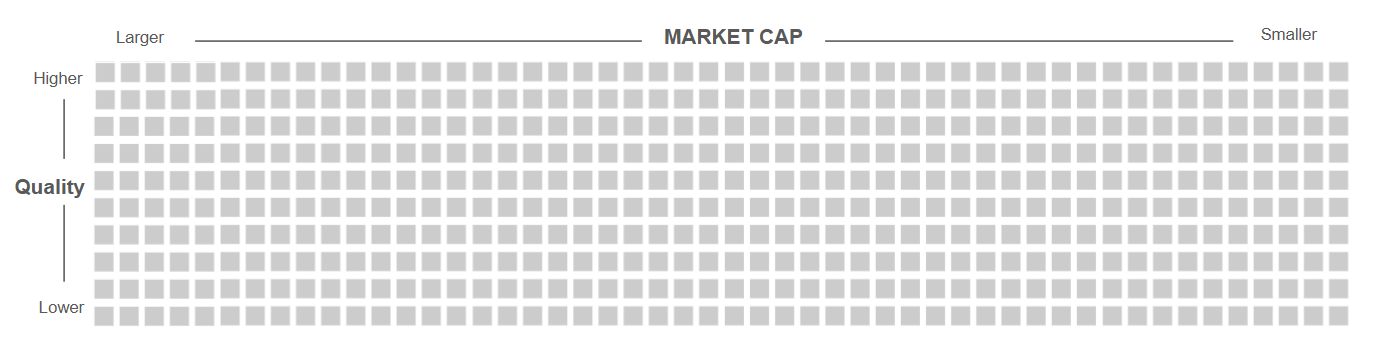
    Here’s a quick graphic to better illustrate how we want to approach this. Imagine each square below represents one company in the S&P 500. We’ve sorted the companies by Market Cap with the larger companies on the left and smaller companies on the right. At the same time, we’ve also sorted the S&P 500 by Quality with the higher quality companies towards the top and the lower quality companies towards the bottom.

    Figure 1: S&P 500 Stocks Sorted By Market Cap and Quality
    We’re now going to carve out the largest companies and the highest quality companies from this universe to focus our investment on the key factors that we want to be exposed to. There are a number of ways to go about this but let’s use two readily available ETFs:

    • Invesco’s S&P 500 Top 50 ETF (ticker: XLG) – invests in the 50 largest companies in the S&P 500
    • Invesco’s S&P 500 Quality ETF (ticker: SPHQ) – invests in the 100 highest quality companies in the S&P 500 as objectively measured by three fundamental measures: return on equity, accruals ratio and financial leverage ratio

    Our exposure to the components of the S&P 500 using these two ETFs now looks something like this:

    Figure 2: S&P 500 Stocks Selected by Large Market Cap and High Quality Exposures
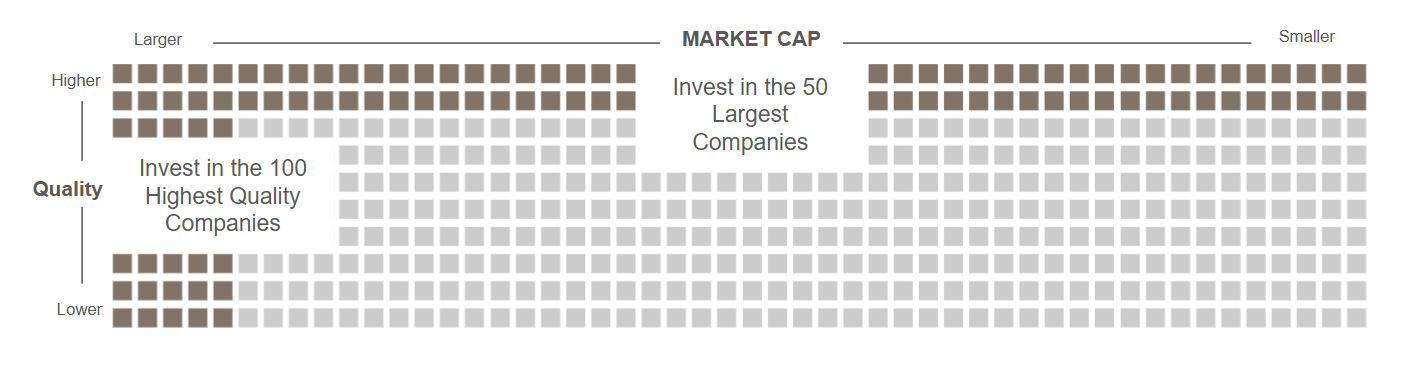
    We’re not just targeting factors, we are also systematically removing lower-quality components of the S&P 500 that introduce uncompensated risk and return drags on the overall portfolio.

    Historical Performance

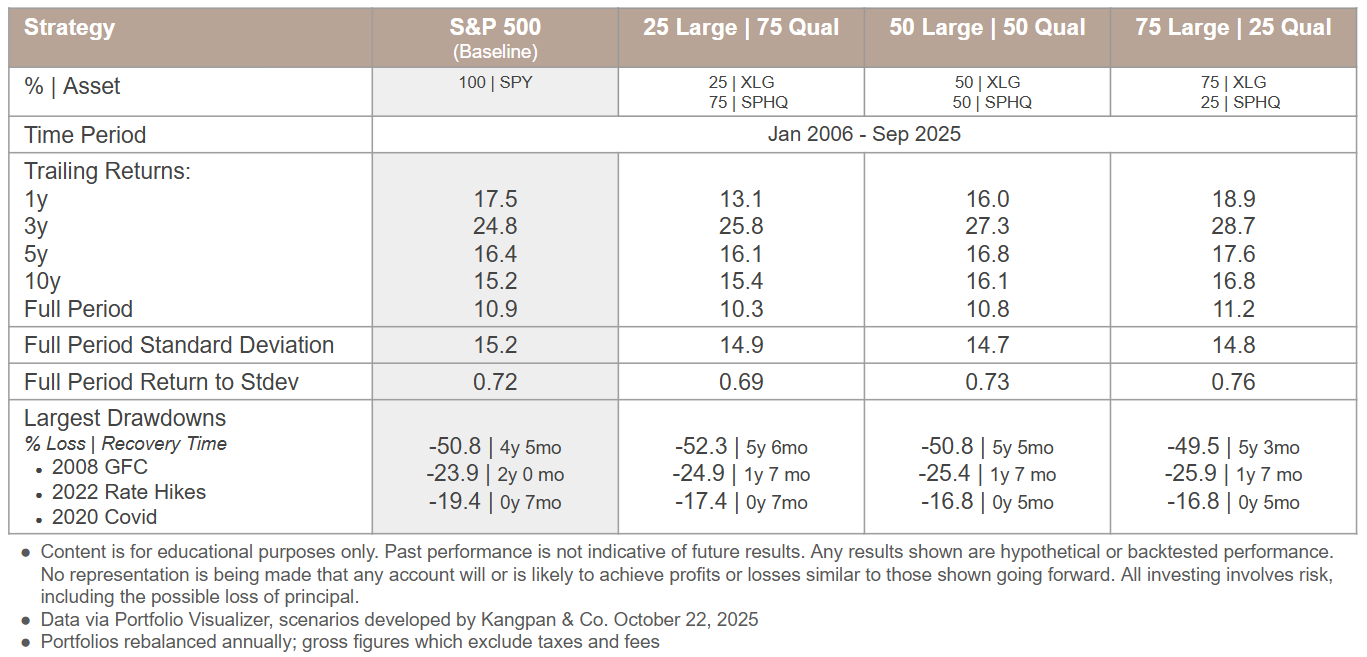
    This strategy makes for an elegant visual representation, but how does it perform? We’ve developed a few scenarios to understand how different proportions of Large Market Cap via XLG and High Quality via SPHQ would have done against the S&P 500 overall which we are representing with State Street’s SPDR S&500 ETF (ticker: SPY).

    Each column in the table below represents a different investment strategy with the first column serving as the baseline comparison of being 100% invested in SPY. The next three columns represent different % XLG | % SPHQ ratios. The timeframe covers Jan 2006 (when XLG and SPHQ performance data was first available via Portfolio Visualizer) through Sep 2025.

    Figure 3: XLG + SPHQ vs. SPY Metrics
    We apply this kind of quantified, systematic analysis to every facet of investment management. Reach out to us for a complimentary 30-minute Portfolio Efficiency Diagnostic Preview to learn about how our systematic analyses and processes could help you better optimize your portfolio for your needs.

    email: [email protected]

    There are a few things we’d like to draw your attention towards:

    • Annualized trailing returns tend to increase as the proportion of XLG to SPHQ rises across most of the assessed time periods
    • The reward to risk ratio of the strategy (as measured by the Full Period Return to Stdev metric) also tends to improve as increasing levels of XLG are added relative to SPHQ
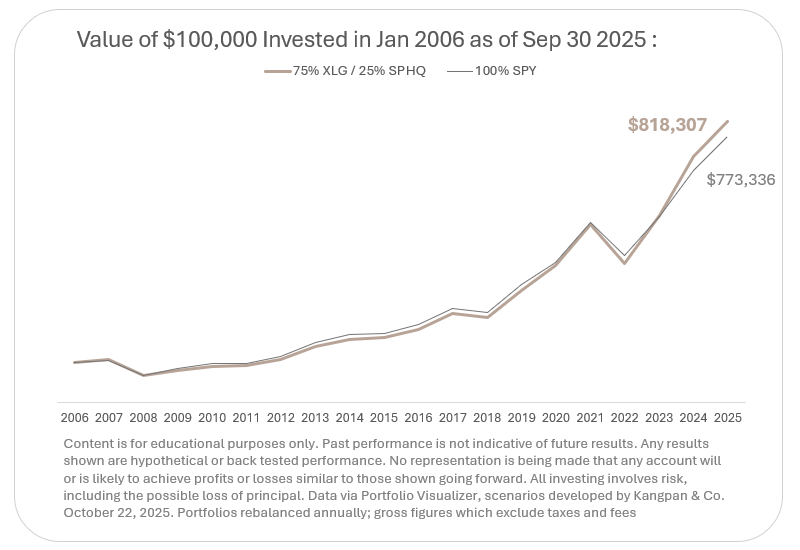
    • The 75% XLG / 25% SPHQ portfolio outperformed SPY across every assessed time period and also exhibited a slightly better overall Return to Stdev. As the table below shows, $100,000 invested in SPY in January 2006 would have been worth $773,336 by the end of September 2025. That same amount invested for in a portfolio of 75% XLG / 25% SPHQ over that same time period would have resulted in an ending balance of $818,307.
    Implications

    This is an educational analysis highlighting how selectively weighting a US Large Cap position towards various factors can impact return and risk measures vs. the overall S&P 500 index. However, we do not advocate switching a portfolio’s S&P 500 allocations to a static 75% XLG / 25% SPHQ based purely on this analysis. The past decade has seen a very rapid market cap growth in the largest stocks of the S&P 500 which this strategy would have been well-positioned to capture. As of the date of this post, the top 50 companies make up ~60% of the index’s overall market cap with concentration of the top companies reaching historically high levels according to analysts as firms such as Columbia Threadneedle. A 75% weighting to XLG represents an even greater concentration than the current market weighting.

    We incorporate the insights (not the fixed weightings) from this analysis into the portfolios we manage for our clients. We believe the strategic use of different factor ETFs in general is beneficial for systematically increasing or reducing varying exposures to optimize portfolio outcomes for different investors’ objectives.

    Email us to schedule a complimentary 30-minute Portfolio Efficiency Diagnostic Preview if you’re interested in learning how our systematic processes could improve your portfolio’s after-tax returns, optimize it’s reward-to-risk ratio, or incorporate an asset mix that better aligns to your long-term goals.

    email: [email protected]

    Disclosures:
    This content is for educational purposes only and is not investment, tax, or legal advice. Employees and clients of Kangpan & Co. may hold positions in securities discussed in this post. Speak with a licensed tax, legal, or financial advisor before making any changes to your investments or financial strategies. Past performance is no guarantee of future returns. Investing involves risk including the loss of capital.
  • Portfolio Efficiency Diagnostic: Quantifying Hidden Tax, Fee, and Performance Drags

    This post details our approach to maximizing the after-tax and after-fee efficiency of a client’s investment portfolios using a Diagnostic. Check out our primer posts on Systematic Optimization  and  Diagnostics to learn more about our unique approach to financial advisory.

    Our Portfolio Efficiency Diagnostic examines opportunities to improve after-tax returns across your portfolio while also systematically looking for places to reduce overall fees and performance drags. Industry research shows the optimizations included in this Diagnostic could have a sizable impact on long-term portfolio returns through improvements such as:

    • Tax-Efficient Asset Location: which can result in 0.14 – 0.41% boosts to yearly after-tax returns according to Schwab
    • Tax-Loss Harvesting: that could lead to 1-2% a year in potential tax savings over 10 years according to JP Morgan
    • Fund Type Optimization: which could reduce fees by 0.51% a year, the average difference in fees between mutual funds and ETFs according to Morningstar

    As with all our Diagnostics, our structured approach ensures we are comprehensively examining your situation in a methodical way, quantifying the tradeoffs that matter, and then aligning your path forward to your unique goals. Our Diagnostics evolve over time as we identify additional analyses and Systematic Optimizations through our ongoing research and work with clients.

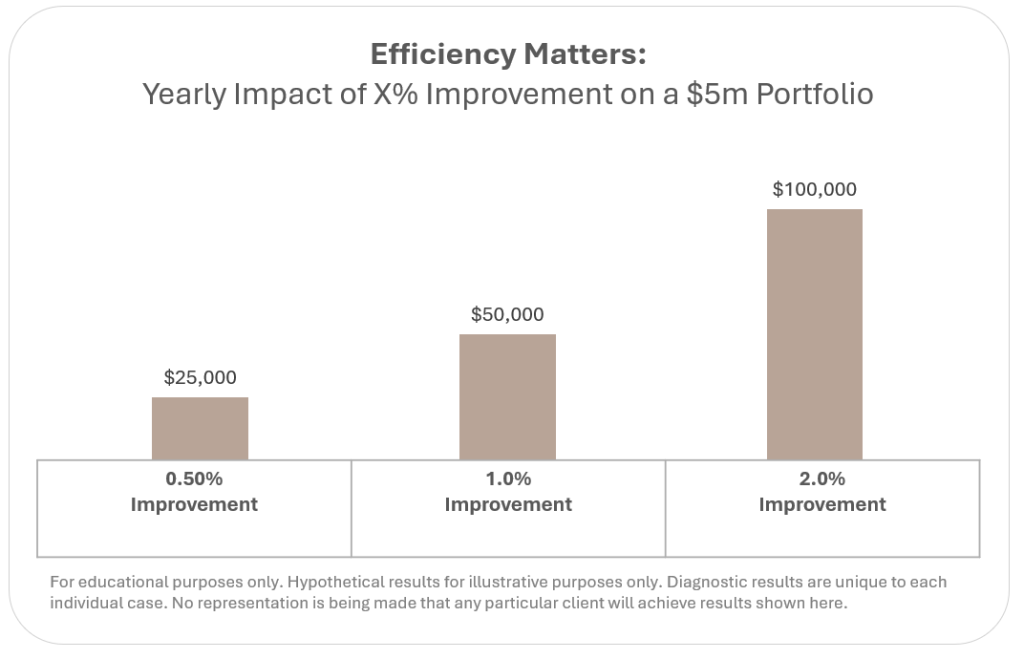
    Seemingly small efficiency improvements can have significant immediate and long-term impacts on a portfolio’s returns. As the chart below shows, just 0.50% improvement on a $5 million portfolio could result in $25,000 a year in additional after-tax wealth accruing to an investor.

    The Portfolio Efficiency Diagnostic

    Our Portfolio Efficiency Diagnostic currently contains ten primary Systematic Optimizations supported by dozens of detailed analyses as shown in the table below. All analyses and recommendations are provided to the client as part of our deliverable.

    Table 1: Our Portfolio Efficiency Diagnostic as of October 2025

    Systematic OptimizationsSupporting Analyses
    01: Minimize Index Fees– Identify index-tracking funds within portfolios
    – Compare expense ratios and fund fees vs. similar funds
    – Determine cost-savings opportunities from moving to lower fee alternatives
    See example
    02: Fund Type Optimization– Compare fully-loaded fees on any mutual funds being held with their ETF equivalents
    – Quantify cost impact of switching to lower fee alternatives
    02: Optimize Custodian Fees– Assess trading and brokerage fees across accounts
    – Calculate admin / custodial fees across accounts
    – Determine cost-savings from migrating accounts and providers
    03: Cash Yield– Calculate total cash holdings and corresponding after-tax yield
    – Compare after-tax yield of alternatives
    – Optimize cash positions across accounts to maximize after-tax yield
    See example
    04: Tax-Efficient Asset Location– Calculate current tax load on equity dividends and bond distributions across accounts
    – Determine potential tax efficiencies from moving higher yield and higher tax investments to tax-advantaged accounts
    See example
    05: Tax-Efficient Asset Types – Calculate current tax load on fixed income bond fund distributions across accounts
    – Compare potential tax efficiencies from moving to municipal and other tax-advantaged, fixed income instruments
    06: Tax-Loss / Tax-Gain Harvesting– Identify positions and lots with losses
    – Identify positions and lots with gains
    – Quantify opportunities for optimal tax-loss / tax-gain management
    – Determine opportunities for loss deductions and carryovers
    07: Asset Performance Benchmarks– Compare performance of individual, non-index funds to indexed equivalents
    – Understand performance optimization opportunities from moving to passive index equivalents
    08: Portfolio Performance Benchmarks– Compare performance of overall portfolio to common benchmarks i.e. 60/40 or our Core Portfolios to understand performance and risk optimization opportunities
    09: Account Types – Catalog current accounts and types (i.e. tax advantaged vs. brokerage, etc.)
    – Identify any gaps in account types that could improve after-tax results
    10: Contributions and Funding Strategies – Ensure funding and contribution strategies are maximizing after-tax results or aligned to long term goals (i.e. early retirement, withdrawal needs, etc.)

    Client Implementation

    This Diagnostic is available to our financial planning clients as part of their ongoing deep dives.

    If you’re not already a client, you might currently be paying for management and planning that is not delivering these systematic optimizations. The only way to stop the hidden drags in your portfolio is through an objective, rules-based audit.

    Our Portfolio Efficiency Diagnostic is available for a flat-fee engagement (typically $1,000 to $10,000), which is always priced to be significantly less than the expected quantifiable tax and fee savings we identify.

    Stop guessing about your hidden tax, fee, and performance drags and start executing an optimized playbook to address these issues. Email us to schedule a complimentary 30-minute Portfolio Efficiency Diagnostic Preview to learn more about what we could do for you.

    email: [email protected]

    Disclosures:
    This content is for educational purposes only and is not an investment recommendation. Employees and clients of Kangpan & Co. may hold positions in securities discussed in this post. Speak with a licensed financial advisor before making any changes to your investments. Past performance is no guarantee of future returns. Investing involves risk including the loss of capital.

  • 529 Plan Diagnostic Details

    This post details our approach to optimizing a client’s college savings strategy using a Diagnostic. Check out our primer posts on Systematic Optimization and Diagnostics to learn more about our unique approach to financial advisory .

    It’s common to wonder whether you’re saving enough for your children’s educational needs and to also be unsure what the tradeoffs are to being underfunded vs. overfunded. Our 529 Plan Diagnostic is designed to quickly give clear answers to these and other common questions while enabling us to provide a comprehensive, tailored recommendation for improving your overall approach to college savings.

    As with all our Diagnostics, this structured approach ensures we are comprehensively examining your situation in a methodical way, quantifying the tradeoffs that matter, and then aligning your path forward to your unique goals. Our Diagnostics evolve over time as we identify additional analyses and Systematic Optimizations through our ongoing research and work with clients.

    Sample Analysis
    See what a deliverable looks like via a blinded detailed 529 analysis here.

    The 529 Diagnostic

    Our 529 Diagnostic currently contains five primary Systematic Optimizations supported by 12 detailed analyses as shown in the table below. All analyses and recommendations are provided to the client as part of our deliverable.

    Table 1: Our 529 Plan Optimization Diagnostic as of October 2025

    Systematic OptimizationsSupporting Analyses
    01: Optimize contribution strategy to reach target educational funding needs– Quantify the expected future cost of college
    – Model expected % of costs funded by plan based on current value of account(s) and contribution strategy
    – Calculate revised contribution strategy necessary to reach target funding %
    02: Define optimal investment allocation path to funding educational needs – Define target equity / bond mix by each investment year
    – Identify which funds to use within the specific 529 plan to implement the investment strategy
    03: Optimize 529 tax and funding benefits– Quantify the incremental tax benefits of using 529 plan to save for college costs
    – Balance tax benefits with potential costs of being overfunded and other opportunity costs
    04: Determine which state’s 529 plan is optimal– Calculate current plan costs vs. tax benefits
    – Compare against other state plans to identify opportunities for total cost improvements
    05: Develop mitigation strategy to minimize costs of being overfunded (if plan will be overfunded) – Quantify the incremental costs of being overfunded
    – Reduce costs through direct mitigation (i.e. Roth Rollover, Beneficiary Updates)
    – Further reduce costs through tax rate management

    Client Implementation

    This Diagnostic is available to our financial planning clients as part of their ongoing deep dives or can be purchased as a standalone, flat-fee project. Email us if you’d like to discuss anything in more detail or learn more about our services.

    email: [email protected]

    Disclosures:
    This content is for educational purposes only and is not an investment recommendation. Employees and clients of Kangpan & Co. may hold positions in securities discussed in this post. Speak with a licensed financial advisor before making any changes to your investments. Past performance is no guarantee of future returns. Investing involves risk including the loss of capital.

  • SPY vs. VOO? Don’t Overpay For Your S&P 500 Position

    This is going to be a short one. I’m surprised how often I come across individual investors who hold State Street’s SPDR S&P 500 ETF Trust (ticker: SPY) over Vanguard’s S&P 500 ETF (ticker: VOO). What’s the difference between these two? Not a lot besides fees, at least for the typical medium to long-term investor1.

    As of the date of this post, SPY has an expense ratio of 0.0945% while VOO sits at 0.03%. That means for every $1,000,000 invested in SPY, you are paying $945 a year in fees to iShares. The same amount invested in VOO translates to $300 a year going to Vanguard. This is a $645 a year difference for two very similar products that track the same index.

    Paying the lowest fee for a fund isn’t necessarily the best strategy to pursue when you are looking across different types of strategies. An alternative credit ETF has a different operational setup and risk / return profile than a large cap index ETF. But fees are very important when comparing funds that track the same strategy and index.

    If all things are more or less equal between two ETFs, then the lower fee version should have consistently higher returns roughly equal to the gap in fees. Let’s take a look at the average annual performance for SPY vs. VOO to see if the lower fees on VOO appear to translate to higher returns:

    TickerYTD1yr3yr5yr 10yr
    SPY10.71%15.85%19.40%14.64%14.46%
    VOO10.79%15.96%19.53%14.70%14.57%

    Market price returns are before tax and inclusive of reinvested dividends and net of fund fees as of August 31, 2025. Data from each provider’s website.

    What you see is a pretty consistent 0.06% to 0.13% performance lag from SPY vs. VOO across all time periods above. Other factors can affect performance such as tracking error as well as premiums / discounts to NAV but we believe the fee difference is a significant contributor to the performance difference in this case.

    This is an example where knowing what to do (invest in a low-cost S&P 500 ETF) is not the same thing as knowing how to do it optimally. We focus a lot on the optimal here at Kangpan & Co. since we believe even seemingly small Systematic Enhancements can compound into significant benefits to our clients over time. In this case, it’s not just the $645 a year for every $1,000,000 a client has invested in a S&P 500 tracker. It’s the tens of thousands of dollars that translates into when you consider a) that fee difference is lost to the investor every year and b) those fees lost out on reinvested compounding returns.

    As a reminder, we do not accept commissions or other forms of direct compensation from any third parties. This post is our own unbiased research and analysis.

    Email us if you’d like to discuss anything in more detail or learn more about our services.

    email: [email protected]

    Disclosures:
    This content is for educational purposes only and is not an investment recommendation. Employees and clients of Kangpan & Co. may hold positions in securities discussed in this post. Speak with a licensed financial advisor before making any changes to your investments. Past performance is no guarantee of future returns. Investing involves risk including the loss of capital.

    1. There are other considerations such as differences in liquidity, premium / discount to NAV, etc. that could impact some types of investors such as very active traders