Tag: tax alpha

  • Case Study: How We Found A High-Earning NY Couple $3,334 in Tax Optimizations Their Old Advisor Was Overlooking

    A Brief Message From
    Our Founder

    One of the reasons I got into wealth management was the desire to have a direct and measurable impact on the financial lives of the clients I serve. This case study is an example of how we use our proprietary capabilities to uncover core tax optimizations that our clients’ previous advisors typically overlook. There is nothing more rewarding than providing immediate, tangible results within the first few conversations with a new partner.
    Nathan Kangpan

    Our Clients Were
    Being Underserved
    By Their Prior Advisor

    Our clients are a high-earning, married couple in their 30’s living in New York. They have a combined income in the high six figures and gross investable assets approaching $1m. They came to us because they were unhappy with the advisor they were working with at the time, sensing (correctly) that their old advisor was overlooking many strategies that could help them put thousands more a year towards their financial goals.

    Four Core Recommendations
    That Drove Thousands In
    Tax Optimizations

    “It’s crazy just how much better your approach is compared to our old advisor.”

    – Client Feedback During Initial Performance Review

    We started the relationship by building a comprehensive, dynamic financial plan that would help us fully understood the couple’s financial situation as well as their short, medium, and long-term goals.

    Once we had a holistic picture, we were able to focus our proprietary series of diagnostics on the critical tax, planning, and investment optimizations that would help them put thousands more per year towards their goals.

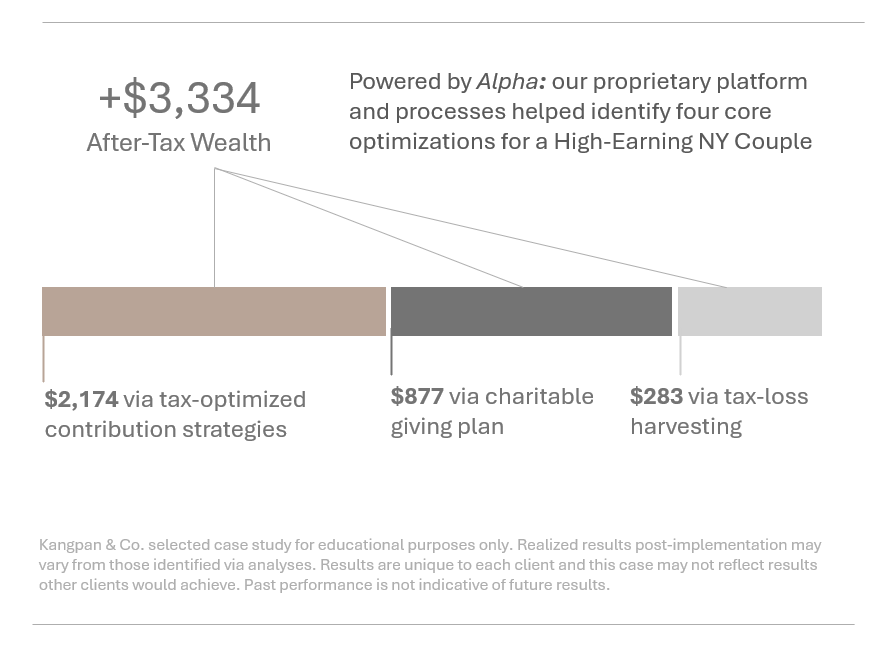
    We went through our full suite of tax, investment, and planning diagnostics during the onboarding process. While we delivered value across all three of those categories, we want to use this case study just to highlight the key tax opportunities we identified:

    • Saving for College Before the Stork Arrives: The couple are planning to but do not yet have children. As a highly educated couple, they prioritize college savings in their long-term financial goals and were planning on opening a 529 Plan once they had children. Many couples are unaware that you can open 529 Plans before your kids are born to a) get a head start on saving but also b) start taking advantage of the tax benefits now. We modeled out the tax and long-term savings impact of our clients starting their 529 this year and also helped them set up and fund their account to begin taking advantage of all the tax benefits.
    • Health, Wealth, and a Triple-Tax Advantage: One of the clients has had an HSA for years into which their employer has been contributing $1,000 a year. However, the client had not been adding any additional funds since they felt they were young and healthy and had no need for putting funds into the HSA. We walked them through the triple-tax advantages of the account and also helped them understand how HSAs can function like an additional retirement account once they turned 65… when the funds can be tapped penalty-free for non-healthcare spending.
    • Maximizing Charitable Giving By Waiting for the New Year: Our clients donate to several charities each year. While the amounts are generous, they are not high enough for our clients to itemize. However, in 2026, the OBBBA tax changes will allow couples filing jointly to deduct up to $2,000 in qualified charitable cash donations, even if they take the standard deduction. Based on this change, we advised our clients to wait until Jan 1, 2026 to make some of their planned donations to take advantage of this new deduction policy.
    • Continuous Tax-Loss Harvesting: We identified and realized multiple tax-loss harvesting opportunities as we migrated the clients’ portfolios towards our recommended allocations. While many advisors only look at tax-loss harvesting once a year (if that), we implement it year round to continuously capture opportunities as they present themselves.

    These four optimizations alone added up to more than $3,334 in additional after-tax income that the client was able to build.

    See What Tax
    Opportunities You
    Might Be Overlooking

    We are always proud of the incremental value we identify for our clients and love building a trusted, collaborative partnership developing strategies together to help each optimize their financial future.

    Have one of our advisors help you with a complimentary, 30-minute Tax-Strategy Diagnostic consultation if you’d like to see what kind of value your current advisor or strategies might be missing.

    We’ll be in touch soon!
    Warning

    Disclosures: This is a real-life client case study. The clients in this case study have agreed to be featured in Kangpan & Co.’s materials without any form of direct or indirect compensation. All results are specific to each individual client’s unique circumstances and may not be representative of results other clients would achieve. The clients in this case study have also offered to serve as references to anyone considering Kangpan & Co. and would like to hear what working with our firm is like from actual clients. They receive no form of direct or indirect compensation for serving as a reference.

  • Tax Alpha: Municipal Bonds Aren’t Always the Best Yielding Option for High Earners

    Executive Summary

    Municipal bonds are often recommended to higher earners by advisors due to their tax benefits (the interest payments are excluded from federal taxes). But, unless you’re living off the income from your portfolio, you could be earning a higher yield by sticking with taxable bond funds held in non-taxable accounts.

    Increasing After-Tax Yields By $4,250 on a $500k Bond Position

    Let’s go through a detailed, hypothetical example.

    Investor Profile:

    Let’s say you and your spouse are in your late 30s and together earn $460,000 a year. This puts you in the 32% federal tax bracket if you’re filing jointly. We’ll ignore the net investment income, state and local tax for now to keep things simple.

    You have $2.5m in total investable assets of which:

    • $1.25m is in tax-advantaged retirement accounts
    • $1.25m is in taxable accounts
    • You are targeting a 60% stocks / 40% bonds allocation across your investments
    • This equates to $1m total in bonds across your account types or roughly $500k in retirement accounts and $500k in taxable accounts

    Investment Options:

    Let’s compare two ETFs that are reasonable municipal and taxable bond equivalents. Here are the the key stats as of Dec 5, 2025 for these two options:

    • The iShares National Muni Bond ETF (ticker: MUB) has a 30-day SEC yield of 3.32%
    • The iShares Core US Aggregate Bond ETF (ticker: AGG) has a 30-day SEC yield of 4.17%

    Note, these two do have slightly different characteristics when it comes to underlying credit risks, overall duration of the fund, etc. But they are similar enough across these traits that many advisors would likely use them interchangeably depending on a client’s tax status.

    Analyzing Pre and Post-Tax Yields:

    Let’s take a look at the numbers.

    Table 1: Pre and Post-Tax Yields Between Bond Fund Types

    iShares National Muni
    Bond ETF (MUB)
    iShares Core US Aggregate
    Bond ETF (AGG)
    Amount Invested$500k$500k
    30 Day SEC Yield
    (as of Dec 5, 2025)
    3.32%4.17%
    Implied Yearly Pre-Tax Payments at 30D SEC Yield$16,600$20,850
    Implied Yearly After-Tax Payments (Assuming 32% Federal Tax Rate)$16,600$14,178

    The table above provides a clear illustration of why many advisors and DIY investors prefer to hold municipal bonds in taxable accounts.

    The after-tax yield (last row) is $2,422 higher than than the taxable bonds since the municipal bond funds are generally exempt from federal taxes. This is despite the pre-tax yield on the taxable bonds being $4,250 more than the muni bonds.

    This is where a lot of advisors or DIY investors would stop the analysis. It’s pretty clear here that this family should put their bond allocation into munis instead of taxable bonds.

    Going One Step Further:

    What if we could keep all of the $20,850 from the taxable bonds instead of paying taxes on it?

    You can do this by treating your accounts as one integrated portfolio rather than two separate taxable vs. retirement account buckets.

    Instead of holding a consistent ratio of 60% stocks and 40% bonds across each of your taxable and retirement accounts, you can optimize by putting your all of your higher yield, higher tax investments (like taxable bond funds) in your retirement accounts and move more of your lower yield, lower tax investments (like stock index funds) into your taxable accounts.

    Let’s illustrate what we’re talking about with another quick table.

    Table 2: Portfolio Allocation Strategies

    Current Portfolio StrategyTax and Yield Optimized Strategy
    Total Stocks & Bonds Across Accounts ($2.5m Total)$1.5m Stocks
    $1.0m Bonds
    $1.5m Stocks
    $1.0m Bonds
    Taxable Accounts
    ($1.25m Total)
    $500k Bonds
    $750k Stocks
    $1.25m Stocks
    $0 Bonds
    Retirement Accounts
    ($1.25m Total)
    $500k Bonds
    $750k Stocks
    $1.0m Bonds
    $250k Stocks

    In the table above, the Current Portfolio Strategy holds a 60% stocks / 40% bonds mix across both their taxable accounts and retirement accounts. The Tax and Yield Optimized Strategy swaps all the bonds out of the taxable accounts in place for stocks.

    The total amount of money allocated to stocks and bonds stays consistent between the two strategies so you can maintain your overall risk profile. We are just moving the bond allocation out of the taxable accounts and into the retirement accounts where they are sheltered from taxes allowing you to capture all of the incremental yield they produce.

    In this case, this strategy means instead of accepting the lower overall yield of $16,600 from the muni bond fund held in your taxable account, you could capture the full $20,850 yield from the taxable bond fund by holding it in your non-taxable account.

    This is what smart, tax-efficient investing is all about.

    Learn more about tax-efficient asset location strategies Links to article about tax-efficient asset location strategies

    Real World Implications

    This was an overly simplified example to help illustrate how tax-smart strategies can improve portfolio yield. In the real world, you would need to take into account other factors such as:

    • The total return of investments outside of the yield
    • What investments you have available in your retirement accounts
    • Capital gains taxes from making large allocation shifts in your taxable accounts
    • The yield on your stock allocations
    • Your specific federal, state, local, and other tax situation

    This, and other analyses like it, are part of the Tax, Portfolio, and Planning optimizations our advisors run for clients assisted by our proprietary Alpha platform.

    Reach out to us if you’d like a complimentary, 30-minute lightweight Diagnostic consultation to learn more about how our unique tech-augmented process helps investors identify high value tax, portfolio, and planning opportunities that other advisors and strategies miss.

    Email us at: [email protected]

    Disclosures:
    This content is for educational purposes only and is not investment, tax, or legal advice. No post is an endorsement of any particular strategy or security. We do not receive any direct payments or commissions for securities discussed in our posts. Employees and clients of Kangpan & Co. may hold positions in securities discussed in posts. Speak with a licensed tax, legal, or financial advisor before making any changes to your investments or financial strategies. Past performance is no guarantee of future returns. Investing involves risk including the loss of capital.