Tag: alternatives

  • Our Core Portfolio Strategies

    This post provides more detail on how we develop a Core portfolio strategy for our clients. This post should also help potential clients better understand how our mindset and approach may be different from the typical advisor.

    The Role of the Core Portfolio

    Designing and managing a Core portfolio is one of the foundational investment management services we provide to clients. As the name implies, the Core portfolio should be the reliable engine to take an investor from where they are today to where they want to be in the future with as minimal drama as possible. The Core portfolio is where an investor will keep the majority of their assets. This means a Core portfolio must adhere to our three key investing tenets:

    • Short term returns for any asset class are unpredictable so a Core portfolio needs to be truly and widely diversified across uncorrelated asset classes
    • Base rates are a strong guide to long-term returns so we should make decisions on which assets to include and in what proportions based on robust historical data that covers a wide range of business and economic cycles; these assets will be held for the long term and rebalanced to target allocations rather than actively traded
    • Avoid permanent losses of capital in this portfolio by focusing on funds of diversified assets and strategies with established, audited track records rather than becoming overly concentrated in individual stocks or securities; we will be methodical in how we administer the portfolio such as minimizing tax drags based on where we locate assets, rebalancing the portfolio, and selecting funds to be included

    The Core portfolio is primarily composed of a customized mix of low-cost, diversified ETFs across the following asset categories:

    • Equities (Stocks): These are the primary drivers of long-term returns within most portfolios. Depending on a client’s comfort with risks and return objectives, we integrate a mix of equities that span different geographies (i.e. US, International) and different factors (i.e. Large Cap Growth, Small Cap Value)
    • Fixed Income (Bonds): These can be used to provide steady income within a portfolio or function as ballast for when equities experience stress periods. Depending on a client’s income needs and risk tolerance we will look to include fixed income options that span a range of durations and credit qualities.
    • Alternatives: These are investments we use to further diversify the mix of Stocks and Bonds in a portfolio ideally seeking to increase returns while reducing overall risks. Assets used here could include commodities such as gold, managed futures, structured credit, etc.

    Our comfort with alternative investments is one of the traits that makes us different from typical advisors. For examples on how we think about how alternatives can improve the return / risk profile of a portfolio, check out our post about gold’s role in portfolio or our post about how structured credit like AAA CLOs can enhance yields.

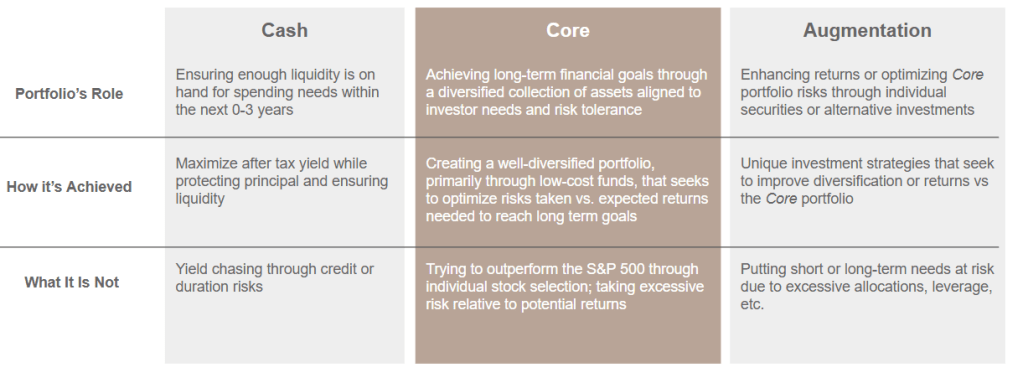
    While the Core portfolio generally does the bulk of the heavy lifting for an investor, it’s important to point out that we feel investors should have two other types of portfolios to form a well-rounded investment plan: a Cash portfolio and an Augmentation portfolio. The table below highlights key aspects of each portfolio and we will discuss the other two portfolios in more depth in future posts.
    Building a Client’s Core Portfolio

    While there are common building blocks across the Core portfolios we manage, we customize each one to the unique needs and risk tolerances of every client. This is typically done by following three key steps.

    Step I: Understand a client’s goals and timeframes to establish a target return

    In order to determine what return we need from our portfolio, we first need to figure out where we are at and where we are trying to go. Many investors have a vague sense of wanting to “retire earlier” or “build more wealth,” but we need to better quantify those notions in order to create objective targets. Once we know our goals, we can then figure out what return we need from our portfolio. This is something we work closely with our clients to understand before we make any investments.

    Let’s go through an example to help illustrate what we’re talking about.

    The Johnson’s are a family of two working professionals in their mid 40’s with two kids. They currently have an investable portfolio of $1.8 million and want to retire in 10 years with $7.5 million. They expect to be able to add $200,000 a year to their investable assets between now and then.

    Using our dynamic planning tools, we determine together that they will need to earn a return of at least 8.9% a year over the next 10 years to reach their $7.5 million goal.
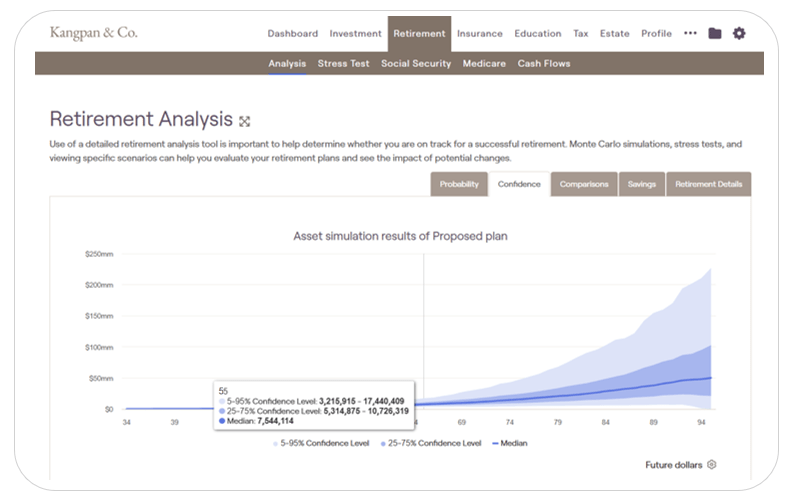
    We use sophisticated modeling to convert vague goals into objective return targets.

    Illustrative example using Kangpan & Co. planning tools to determine expected asset levels along with associated confidence intervals. Modified for demonstration purposes.

    Step 2: Understand a client’s comfort with risk and return to establish a baseline allocation using traditional assets (i.e. Stock and Bond mix)

    The baseline rate of return of a Core portfolio is predominantly determined by its ratio of Stocks to Bonds. This forms the baseline allocation of the portfolio. Alternatives, which we discuss in the next step, are used to manage the risk profile of a portfolio.

    The table below shows the long-term historical performance and key risk metrics of various mixes of Stocks/Bonds that we pulled together using Portfolio Visualizer’s asset backtesting module. We show tables like this to clients to guide conversations about what baseline mix should be used as a starting point to reach their return goals.

    Each column represents the results for a different mix of Stocks/Bonds with Stocks represented by US Large Caps (a proxy for the S&P 500) and Bonds represented by 10yr Treasuries. For example, the column 100/0 is a portfolio comprised of 100% Stocks and 0% Bonds while the 60/40 column is a portfolio of 60% Stocks and 40% Bonds.

    We can see based on the table that in order for the Johnson family to get their target 8.9% return, they will need to have a portfolio that is somewhere between a 40/60 portfolio (with an 8.5% expected return) and a 60/40 portfolio (with a 9.5% expected return).

    Table 1: Return and Risk Profiles for Various Stock/Bond Portfolio Mixes
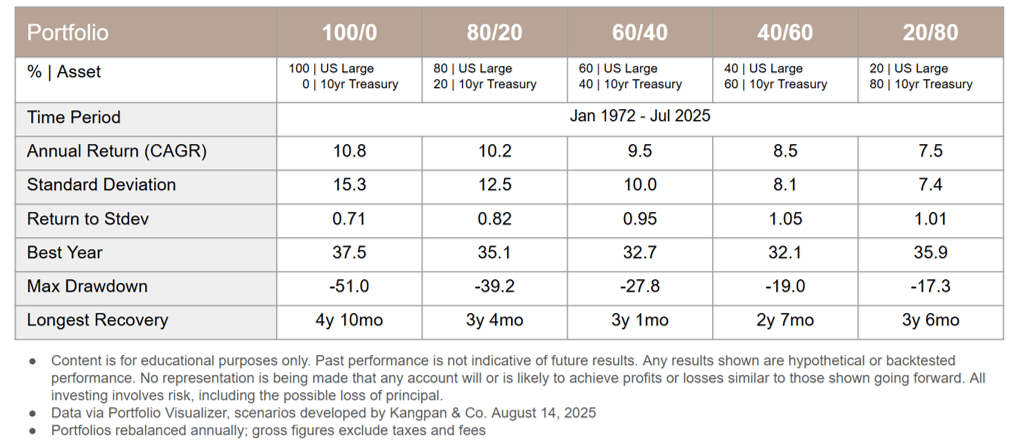
    Return and risk profiles for various mixes of stocks to bonds in a traditional baseline portfolio.

    However, in addition to understanding how returns are affected by the mix of Stocks and Bonds in a portfolio, we also use the data in this table to better understand how our clients feel about risk. Specifically we look at data points like how volatile the portfolio is on a year to year basis, how severe downturns have been (the Max Drawdown metric), and how long each portfolio took to recover from those downturns.

    Step 3: Adjust the return and risk profile of the baseline portfolio to the client’s needs by more broadly diversifying the base asset mix and selectively incorporating alternatives

    Our first step identified what minimum return level we need to target in order to help our client reach their goals on the timeline they desire. Our second step gave us a better understanding of how the client views the tradeoffs between risks and potentially higher returns. These prior two steps give us the inputs we need for our final step with a client… fine-tuning the risk and reward ratios of a baseline Stock and Bond portfolio by introducing additional diversifiers.

    Let’s say in our discussion with the Johnson’s in the prior step that they liked the idea of retiring with $8.3 million instead of $7.5 million if they could earn the historical 10.2% returns of an 80/20 portfolio (who wouldn’t?). However, among other issues, they did not like the amount of additional risk that came with that portfolio’s Max Drawdown of -39.2% vs. the 40/60 portfolio’s -19.0%.

    This is where we can use a wider range of funds and alternative assets to help our clients balance the returns they want with the potential risks of a portfolio. In the table below, we are showing a simplified example of enhancing the portfolio with just two additional asset classes:

    • US Small Cap Value: research shows US Small Caps and Value factors tend to outperform US Large Caps over time
    • Gold: an alternative asset class that can help diversify portfolios consisting of Stocks and Bonds

    Strategically incorporating these two additional asset classes allows us to boost backtested returns to the levels of an 80/20 portfolio while having the risk characteristics more aligned to a 40/60 portfolio:

    Table 2: Returns and Risks for Systematically Enhanced Portfolio vs. Stock / Bond Mixes
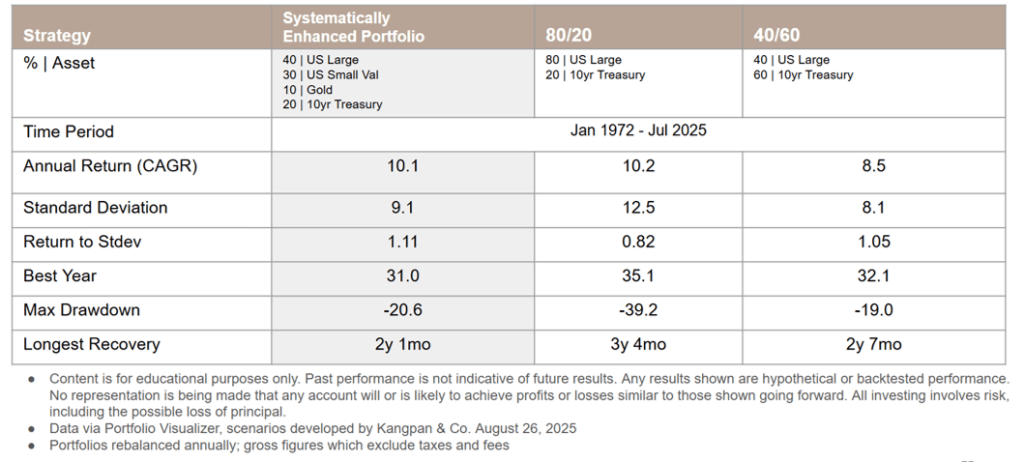
    Incorporating additional asset class exposures such as US Small Cap Value and alternatives such as Gold to a traditional Large Cap and Bond portfolio can enhance risk-adjusted returns

    This is where the power of being open to incorporating alternatives comes into play for clients – we can better engineer a portfolio’s returns and risks to meet the unique needs and desires of each client.

    We primarily use alternatives in publicly available ETFs rather than private options because they are generally:

    • More transparent: so both our advisors and our clients are clear on what is being added to the portfolio
    • More liquid: the tradability of ETFs makes rebalancing or strategic shifts in allocations much easier to accomplish
    • Lower fee: ETFs tend to (but not always) have lower fees than private funds for similar strategies and implementations

    Real-World Client Implementation

    The example in the prior section is purely illustrative and for educational purposes only. In the real world, we look across a much broader set of investable options across stocks, bonds, and alternatives. The actual individual securities and funds we use to set up our clients’ positions which will have a different return and risk profile from those based on overall asset class returns used in our example.

    Our clients benefit from the ongoing research we conduct for each asset class inlcuding:

    • How the asset class relates to the rest of the portfolio by understanding historical correlations, stress periods, return and risk profile, etc.
    • How different allocation weights affect the overall portfolio’s risk and return metrics across various time periods
    • Our preferred fund or individual security(ies) for gaining access to that asset class

    Our selection process for specific securities we use in portfolios depends on the asset class we are researching and our clients’ specific needs. For examples of some of the factors we consider check out our post on selecting an ETF for S&P 500 exposure or our preferred International funds

    Once a Core portfolio strategy has been developed, we then help clients implement and manage the portfolio on an ongoing basis including:

    • Reporting / Monitoring
    • Rebalancing
    • Tax-Loss Harvesting
    • Adding / Removing Assets Over Time

    Our fees and minimums for designing and managing a Core portfolio strategy can be found in the Service Models & Pricing section of our investing services page. We also work with clients on a flat-fee project basis for those that just want access to our portfolio advice and construction process rather than ongoing management.

    Email us if you’d like to discuss anything in more detail or learn more about our services.

    email: [email protected]

    Disclosures:
    This content is for educational purposes only and is not an investment recommendation. Employees and clients of Kangpan & Co. may hold positions in securities discussed in this post. Speak with a licensed financial advisor before making any changes to your investments. Past performance is no guarantee of future returns. Investing involves risk including the loss of capital.
  • How Gold Enhances Portfolio Returns

    This post examines how incorporating gold into a portfolio of US stocks and bonds can improve overall returns as well as lowering overall volatility. We typically use the analyses shown here, in combination with other data points, to guide conversations with clients about including a gold allocation within their Core portfolios.

    There are numerous reasons investors incorporate gold into their portfolio, but ours come down to the following key points:

    • Gold exhibits very low correlation to stocks and bonds of 0.00 to 0.09 since the 1970s, making it a powerful diversifier to a portfolio primarily made up of those assets1
    • Gold is predominantly priced in US dollars across global markets making it a particularly good hedge position for US-based investors2
    • Gold’s long-term return measured in US dollars from 1971 (after being de-linked from the dollar) to 2023 is 8% outpacing US inflation and various US Treasuries3

    We are also well aware of the arguments against holding gold, but we prefer to focus on what real world data says, not on theoretical criticisms. One of the traits that makes us different from other advisors is our focus on empirical evidence and our willingness to do our own homework.

    We’ll explore each of the points in favor of gold in more detail in future posts. For today, we’re going to spend the rest of this article highlighting the historical impact gold has had on a stock and bond portfolio’s returns and risk metrics.

    Portfolio Analysis

    We used Portfolio Visualizer’s “Backtest Asset Allocation” module to develop the analyses shown in the table below. We’ll look at three scenarios to understand how adding gold affects the return and risk characteristics of a 60/40 portfolio. In each scenario below, the ratio of Stocks to Bonds stays at a consistent 60/40 ratio to each other with Gold representing 0%, 5%, and then 10% of the total portfolio mix.

    Table 1: How Gold Impacts a 60/40 Portfolio – Jan 1972 through Aug 2025

    60% Stocks
    40% Bonds
    0% Gold
    57% Stocks
    38% Bonds
    5% Gold
    54% Stocks
    36% Bonds
    10% Gold
    Topline Metrics
    Annual Return (CAGR)9.48%9.60%9.70%
    Annual Stdev10.11%9.70%9.41%
    Return/Stdev0.930.991.03
    Max Drawdown-28.5%-24.5%-22.5%
    Stress Periods
    Dotcom Crash-18.4%-16.8%-15.2%
    Subprime Crisis-26.4%-24.5%-22.5%
    COVID Shock-9.6%-9.1%-8.7%

    For educational purposes only. Data and analytics via Portfolio Visualizer run on September 29, 2025. Scenarios developed and summarized by Kangpan & Co. Assumes yearly rebalancing and does not include the impact of fees or taxes. Stocks are represented by “US Stock Market,” Bonds represented by “10-year Treasury,” and Gold represented by “Gold.” Stress Periods: Dotcom Crash Mar 2000 – Oct 2022, Subprime Crisis Nov 2007 – Mar 2009, COVID Shock Jan 2020 – Mar 2020. Past performance is not indicative of future returns. Investing involves risk including the loss of capital.

    There are two key takeaways from the chart that we want to highlight for readers:

    • Increasing allocations to Gold result in increasing Annual Returns along with decreasing volatility (as measured by the Annual Standard Deviation) thus improving the overall Return/Stdev ratio
    • Incorporating Gold makes the portfolio more resistant to shocks and stress, lowering the observed overall Max Drawdown of the portfolio and reducing the losses experienced across numerous Stress Periods

    Overall, the data and analysis shows adding gold to a standard portfolio of stocks and bonds tends to increase expected annual returns while decreasing its risk profile.

    Implications for Investor Portfolios

    We feel the table above is a compelling set of data points to argue in favor of including gold allocations within traditional stock and bond portfolios. When we work with clients who have an interest in diversifying their portfolio with gold, we will also help them:

    • Identify the optimal starting allocation based on the rest of their portfolio and their overall risk tolerance
    • Determine how to incorporate gold into their portfolio such as utilizing an ETF vs. holding physical gold
    • Manage the additional complexity of including more assets within their portfolio such as rebalancing, broader tax-loss harvesting, etc.

    Email us if you’d like to discuss anything in more detail or learn more about our services.

    email: [email protected]

    Disclosures:
    This content is for educational purposes only and is not an investment recommendation. Employees and clients of Kangpan & Co. may hold positions in securities discussed in this post. Speak with a licensed financial advisor before making any changes to your investments. Past performance is no guarantee of future returns. Investing involves risk including the loss of capital.
    1. https://www.ssga.com/us/en/intermediary/insights/gold-as-a-strategic-asset-class
    2. https://www.cmegroup.com/openmarkets/metals/2025/Gold-and-the-US-Dollar-An-Evolving-Relationship.html
    3. https://www.suerf.org/wp-content/uploads/2025/03/SUERF-Policy-Brief-1119_Johan-Palmberg.pdf

  • Enhancing Short-Term Yields With AAA CLOs

    Wait, CLOs? That sounds vaguely like those things that blew a hole through the economy back in 2008… Close, but it was actually CDOs that contributed to the meltdown. According to VanEck’s William Skol:

    “… not only did CLOs have nothing to do with the Global Financial Crisis, the asset class thrived through the 2008 crisis relative to other fixed income asset classes.”

    Read on if you’re:

    • Looking for ways to increase yield in your portfolio without taking on significant credit risks
    • Interested in alternative credit options available in liquid forms

    As a reminder, we are a fee-only fiduciary advisor and have no compensation arrangements with any of the funds discussed below.

    A Quick CLO Primer

    The love of TLAs (three-letter acronyms) within the financial world plays a part in this confusion between CDOs and CLOs. I spent a summer internship back in the mid-2000s structuring both these and other derivatives, and I still had trouble keeping all the acronyms straight as I was completing my rotation on the desk.

    Collateralized Debt Obligations (CDOs) can be comprised of a variety of debt instruments including unsecured and junior obligations. It was sub-prime mortgage CDOs that played a dominant role in the 2008 collapse. We’re not going to cover CDOs any further in this post.

    Collateralized Loan Obligations (CLOs) are a form structured credit that are generally backed by senior secured loans from corporate borrowers. Senior meaning first in line to be paid if a company experiences financial troubles. Secured meaning they are backed by the company’s assets.

    The underlying loans within a CLO are also usually both liquid and tradable. Each CLO is generally made up of 150-250 individual loans. These loans are then further divided into a layered loss structure called “tranches” where losses are absorbed by each layer in a cascading sequence.

    These layers are rated like other credit instruments from CCC (the riskiest) to AAA (the least risky). In order for AAA-rated CLO tranches to take a loss, all other preceding layers need to have blown out. This makes the AAA-rated CLO tranche a relatively lower risk investment vs. other corporate credit options out there.

    How much lower risk? As the fixed income team at BlackRock points out in their March 17, 2025 article:

    ” … no AAA-rated CLO has ever defaulted.”

    I recommend checking out both the VanEck and BlackRock articles linked above for a more in-depth overview.

    JAAA ETF Overview

    CLOs have been around for decades now but only recently became available in a more easily accessible, liquid ETF form. They come in a variety of versions including those focused just on AAA-rated tranches which is what we’ll spend the rest of this post discussing.

    There are multiple AAA CLO ETFs available (that’s three TLAs in a row if you’re keeping score), but we’ll use Janus Henderson’s (ticker: JAAA) for our analysis which is both the largest by AUM and the one that has been around the longest. Here’s a quick rundown of JAAA’s core attributes:

    MetricJAAA
    Closing Market Price$50.68
    30-Day SEC Yield5.39%
    Net Annual Expense Ratio0.20%
    Number of Holdings453
    Effective Duration (Yrs_0.12
    Returns
    YTD
    1y
    3y

    3.51%
    5.85%
    7.02%

    Via https://www.janushenderson.com/en-us/advisor/product/jaaa-aaa-clo-etf/ ; data as of close on September 17, 2025 except returns which are as of August 31, 2025 and represent total average market-price returns including distributions

    Beyond JAAA’s yield and performance, one of the most important characteristics of JAAA is its very low duration of 0.12 years which (a) gives this fund’s price very low interest rate sensitivity and (b) essentially makes this a floating rate investment.

    We need to put JAAA’s performance in context by comparing against a benchmark asset. Here are a few key traits we need to consider when selecting a comparison asset:

    • A fixed income investment
    • Invested in AAA-rated credits or higher
    • With a very short duration

    These attributes make the iShares 0-3 Month Treasury Bond ETF (ticker: SGOV) a solid contender to compare as the benchmark which is a fixed income product, invested in government debt, with a duration of just 0.09 years. Here are the attributes side-by-side:

    MetricJAAASGOV
    Closing Market Price$50.68$100.57
    AUM$25.2 billion$57.7 billion
    30-Day SEC Yield5.39%4.19%
    Net Annual Expense Ratio0.20%0.09%
    Number of Holdings453na
    Effective Duration (Yrs)0.120.09
    Returns
    YTD
    1y
    3y

    3.51%
    5.85%
    7.02%

    2.1%
    4.51%
    4.80%

    – JAAA data via https://www.janushenderson.com/en-us/advisor/product/jaaa-aaa-clo-etf/
    – SGOV data via https://www.ishares.com/us/products/314116/ishares-0-3-month-treasury-bond-etf
    – Data as of close on September 17, 2025 except returns which are as of August 31, 2025 and represent total average market-price returns including distributions

    A current yield spread of 120 bps and a persistent 134 bps increase in returns vs. short-term treasuries across time periods seems pretty good for a AAA-rated fixed income alternative with similar duration. So what’s the catch?

    JAAA’s Historical Drawdowns

    While the total return for JAAA has exceeded those of SGOV since JAAA’s launch, that return has come with a bit more volatility.

    Unlike short-term treasury funds, short-term AAA CLOs ETFs can and have experienced notable drawdowns due to increased credit exposure and other factors. Let’s explore what these drawdowns have been.

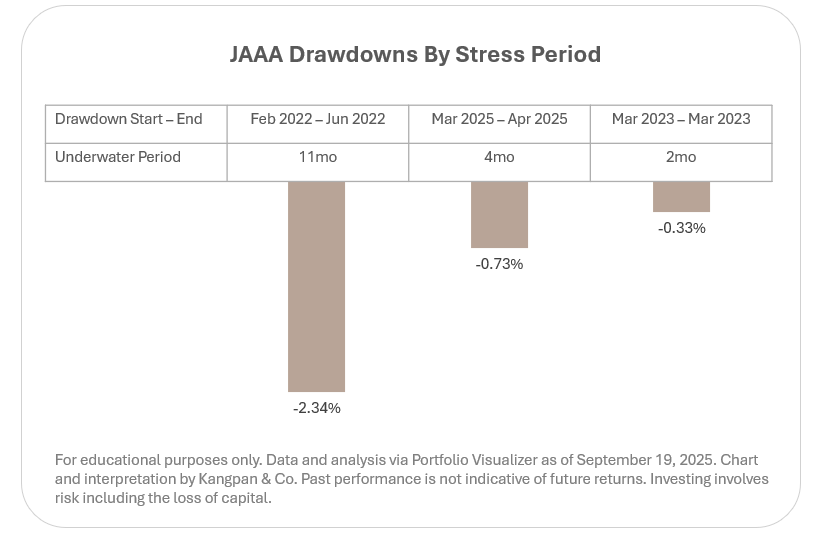
    AAA CLOs have existed for decades but JAAA itself has only been around since October 2020. That means we can only look at a handful of stress periods to get a sense for how well it has held up. The chart below shows the three largest drawdowns for JAAA since launch with the following data points:

    • The start month of each drawdown and the end month when the lowest price was hit for that stress period
    • The Underwater Period which is the length of time between the drawdown start date to when when the investor fully recovered their initial investment inclusive of reinvested distributions
    • The max % total loss experienced (i.e. inclusive of distributions) during the drawdown

    The largest drawdown was during 2022, aka the worst overall bond market since 1949 according to Bank of America and other bond analysts. JAAA’s drop during this time was primarily due to the aggressive rate hikes that resulted in a repricing of CLOs across the board along with increased trading activity among various market participants. However, it’s important to note that the relatively short Underwater Period of 11 months can be attributed to two key factors:

    • The very short duration of JAAA’s holdings which significantly reduces interest rate sensitivity as the holdings mature essentially making its holdings floating rate instruments so as the interest rates ratcheted up, the underlying holdings increased yields with less price impact than many other fixed income investments
    • The underlying changes to NAV were not due to credit issues given none of the holdings defaulted during this time (and, if you recall from earlier, no AAA CLO has ever defaulted as of the date of this post).

    While by no means risk-free, we feel JAAA has held up fairly well under a relatively limited set of stress scenarios. That said, there are other considerations an investor should look into as well when assessing an investment like this such as tax implications, target interest rate exposure, etc.

    Client Portfolio Strategy

    Like many alternatives, AAA CLO ETFs aren’t necessary or even appropriate for every portfolio. Here are common situations where we think about utilizing these investments:

    • Clients with income-centric portfolios that want to enhance their yield within their short-term exposures without taking on significant credit risks
    • Clients with large cash and other liquid holdings that want to further enhance their yield for funds they are not anticipating needing within the next 1-2 years

    There are other situations where we would consider including these liquid alternatives in portfolios based on client needs and risk tolerances which we help clients model out and understand the expected benefits and implications in doing so.

    If you’d like to discuss anything in more detail, reach out to your dedicated advisor if you’re a current client or email us to learn more about our services.

    email: [email protected]

    Disclosures:
    This content is for educational purposes only and is not an investment recommendation. Speak with a licensed financial advisor before making any changes to your investments. Past performance is no guarantee of future returns. Investing involves risk including the loss of capital.